
Dave Manuel Logo
Tuesday, March 16, 2010


FRONT PAGE
STOCK QUOTES
SPECIAL FEATURES
REVIEWS
ARTICLE ARCHIVE
NEWSLETTERS
DICTIONARY
TWITTER ALERTS
STOCK TWEETS
U.S. DEBT CLOCK
U.S. UNEMPLOYMENT
ADVERTISE
ARTICLE FEED
BLOG FEED


2008-10-11 19:38:30

How Have The Major North American Stock Market Indexes Performed Short-Term After Very Bad Years?



logos and arrow building up - dow jones industrial average - nasdaq composite - sp 500 index The Dow Jones Industrial Average, Nasdaq Composite and S+P 500 have all performed very well since their inceptions. Of the three indexes, the Dow Jones Industrial Average was the only one that existed during the Great Depression. The Nasdaq Composite was launched in 1971, and the S+P 500 was technically launched in 1957, though it is possible to extrapolate the data back in time due to the indexes listing requirements.

All three of these indexes are down 30-40% in 2008, which represents a historically awful years for all three indexes. Many people take comfort in the fact that the markets have always bounced back after bear markets, and that this time will be no different.

That may or may not be true - not be be too much of a downer, but a stock market index rebounding past its previous highs is not always necessarily a given. Just a couple of examples for you - the Nikkei 225 set an all-time high of around 39,000 in December of 1989, and has not come even close to matching those heights since. It currently sits at around 8,300 points. The Nasdaq Composite set an all-time high of over 5,000 in early 2000, and currently sits at 1,650 points over eight years later. You can't always count on the markets to bounce back, higher and stronger than ever, because it doesn't always happen.

Anyways, back to the DJIA, Nasdaq and S+P 500. I pulled all of the historical data from all three of the indexes. For the S+P 500, we will be using the extrapolated data that goes all the way back to 1928. For the Nasdaq, I will be going back to the mid 70s. A "very bad" year to me is a 20%+ down year.

Let's start with the S+P 500:

The S+P 500 was down 24.9% in 1930. The following year it lost an additional 43.4%. The year after that (1932), it lost an additional 8.2%.

The S+P 500 was down 35% in 1937, and rebounded strongly the very next year, closing up over 31%. It should be mentioned though, that the three following years were all down years for the index (-0.4%, -9.8% and -11.6%).

The S+P 500 was down 26.5% in 1974. 1975 saw a strong rebound, as the index traded up over 37.2%. 1976 was another strong year, with the S+P 500 adding an additional 23.9%.
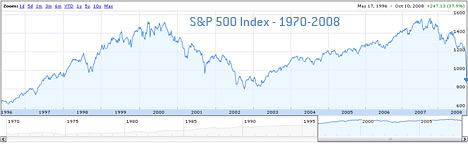


Since then, the S+P 500 has done extremely well, and has not had any "bad" years (not counting 2008 of course).

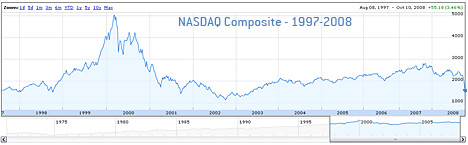
Now, the Nasdaq Composite:

Since 1975, the Nasdaq has had three "very bad" years - 2000, 2001 and 2002. 1990 was a weak year for the index as well, as it lost a total of 17.8%. The three years that followed saw gains of 56.84%, 15.45% and 14.75%.

2000 saw the types of losses that we will end up seeing in 2008, as the index lost a total of 39.29%. The next year saw a loss of 21.05%, while 2002 saw a loss of 31.53% as companies struggled with a 9-11 inspired recession.


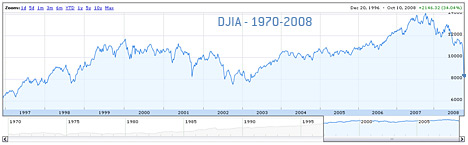
Now, the Dow Jones Industrial Average:

The Dow Jones Industrial Average fell 16.6% in 1973 and 27.5% in 1974. The next year (1975), the Dow Jones Industrial Average posted a very strong 38.3% return, followed by a 17.9% return the next year.

The DJIA fell 33.77% in 1930. Those hoping for a quick rebound were devastated after the DJIA posted a return of 52.67% the very next year, and a return of 23.07% in 1932.

The bottom line? Based on historical data, the REALLY bad years for the indexes tend to be followed by more losses, but this is not always the case. Those who are banking on an immediate turnaround may want to tread carefully over the next few years.


Filed under: The Economic Meltdown | Stock Market Education



Related Articles
-- Warning sign bell - drawing --
Posted on: 2010-03-15 07:44:00
Moody's Fires Another Warning Shot at the United States
-- Hedge fund - 3rd times the charms - illustration --
Posted on: 2010-03-13 06:29:00
John Meriwether - Third Time's A Charm?
-- Unemployment in MIchigan - Automakers - Illustration - Sad cars --
Posted on: 2010-03-11 00:57:00
Unemployment Rate Up in 30 States in January
-- Illustration - Home printer printing U.S. dollar bills - money --
Posted on: 2010-03-10 06:30:00
One Year Ago Today..
-- Illustration of a gold bar / brick  --
Posted on: 2010-03-09 10:11:00
John Paulson's Four Billion Dollar Plus Long Positions


COMMENTS

No comments yet.

Comments are temporarily down.


Stock Market Quotes

Davemanuel.com recently launched its very own stock market quotes page.

1. MOST RECENT NEWS RELEASES

2. MOST RECENT TWITTER POSTINGS

3. MOST RECENT YAHOO FINANCE POSTINGS

4. MOST RECENT BLOG POSTINGS

5. CHARTS


Twitter

246


Dow Jones10660.59+18.440.17%
Nasdaq2372.28+10.070.42%
S&P 5001155.36+4.850.42%


SPECIAL FEATURES

United States Debt Clock

Where Did The DJIA/NASDAQ/S&P 500 Trade On..

History of Deficits and Surpluses in the U.S.

Inflation Calculator

Historical Unemployment Rates in the United States

Historical State Unemployment Rates

Canada Debt Clock

UK National Debt Clock

A History of Bank Failures in the United States

Mortgage Refinancing Calculator

Dow Jones Historical Data

Nasdaq Historical Data

S&P 500 Historical Data

Stock Market Guru Twitter Alerts

Historical Gold Prices

Median Household Income History

State Population Trends Since 2000


BLOG POSTINGS

Always Consider The Source

100 Financial Dictionary Entries

New Tool For Looking Up DJIA / NASDAQ / S&P 500 Historical Data Launches

Beginning of an Era? Ebooks Outsell Physical Books on Amazon.com on Christmas Day

Bernard Madoff Nearly Beaten to Death in Prison

Google Legally Avoids Paying 450 Million Pounds of Tax in Britain Last Year

Historical State Unemployment Rate Tool Launches

How Do The Markets Tend to Perform in December?

More Arrests Made in Galleon Group Insider Trading Case

CNBC Viewership Numbers Are Trending Downwards


FUND HOLDINGS

Farallon Capital Management, L.L.C.

Eton Park Capital Management, L.P.

Conatus Capital Management LP

Bill & Melinda Gates Foundation Trust

Third Point LLC

Paulson and Co. Inc.


REVIEWS

Barbarians at the Gate Book Review

The Dip Book Reviews

Too Big To Fail Book Reviews

Thinkorswim Reviews

Hulbert Interactive Reviews


MOST RECENT DICTIONARY ENTRIES

Material Adverse Change

Ninja Loan

Credit Default Swap

Liar Loan

Mega Cap Stock

Level 3 Assets

Nascent Recovery

Small Cap Stock

Micro Cap Stock

AA Bond Rating


CREDIT CARDS AND OTHER SERVICES

The Top Three Online Stock Brokers In Canada

Questrade Review

Jim Cramer Action Alerts Plus Review

The American Express Platinum Credit Card

Direct Access Brokers: The Best of the Best

Discover More Card Review

American Express Platinum Credit Card Review

American Express Gold Card Review

Questrade Promotional Code - Qualifying for Your Free Commissions

Hulbert Interactive Review

Marketwatch Options Trader Newsletter Review

Retirement Weekly Newsletter Review

Barron's Online Review

Wall Street Journal Subscription - Up to 80% Off Regular Price

Wall Street Journal Subscription Discount

Barron's Subscription Discount - Over 40% Off The Newsstand Price

Barron's Coupon Code


INTERNATIONAL CONTENT

Comment Acheter un Amazon Kindle en France


PROMOTIONS AND OFFERS

Where To Buy a Kindle?

WSJ Subscription Discount - Up to 80% Off

How to Buy an Amazon Kindle in Canada

Amazon Kindle Canada Review

Hercule Poirot DVD Reviews


ARTICLE ARCHIVES

Blog Posts

Company Reviews

Daytrading

General Knowledge

General Market News

Health + Fitness

Hedge Fund News

Internet Companies

Making Money Online

Motivational

Online Forex Trading

Real Estate News

Stock Market Education

Stock Market Scandals

The Economic Meltdown

Trader Profiles


DaveManuel.com - Copyright 2010, All Rights Reserved | Advertise | Privacy Policy | Disclaimer