When Algorithms Panicked: The 2013 Flash Crash
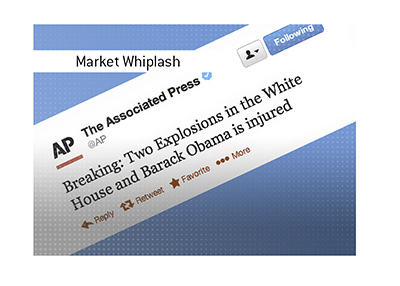 It took just one tweet.
"Breaking: Two Explosions in the White House and Barack Obama is injured."
That message came from the official Twitter account of the Associated Press on April 23, 2013.
It was fake. The account had been hacked.
But the markets didn't wait to verify it.
Within seconds, high-frequency trading algorithms scanned the tweet. They didn't ask questions. They sold.
The Dow Jones Industrial Average dropped 143 points in a heartbeat. The S&P 500 shed almost 1% of its value.
Roughly $136 billion in market cap evaporated in under three minutes.
Then came the reversal. The AP confirmed the hack. The tweet was false. The market recovered just as quickly as it had fallen.
But the damage was done.
This was a new kind of risk - fast, digital, and decentralized.
The Syrian Electronic Army, a group of pro-Assad hackers, took credit. Their goal wasn't to profit. It was to disrupt.
And they succeeded.
The event exposed a glaring vulnerability: how tightly the financial system had become tied to real-time social media.
Traders were stunned. It wasn't just about misinformation - it was about speed. Algorithms had no human filter. No common sense. Just logic.
And the logic said: something terrible just happened. Sell.
The SEC took notice. So did hedge funds and trading platforms. Security protocols changed. So did how firms assessed risk from non-traditional data sources.
But the lesson remains simple.
In a world where headlines can move billions, the source matters less than the reaction speed.
The 2013 AP Twitter hack wasn't just a prank. It was a warning. And it showed that markets can still be shaken by something as small - and as powerful - as 140 characters.
Filed under: General Knowledge