Dave Manuel Logo
Friday, September 03, 2010


FRONT PAGE
FUND REPORT
STOCK QUOTES
SPECIAL FEATURES
FUND HOLDINGS
NEWSLETTERS
TWITTER ALERTS
STOCK TWEETS
ARTICLE ARCHIVE
DICTIONARY
U.S. DEBT CLOCK
U.S. UNEMPLOYMENT
ANSWERS
REVIEWS
ADVERTISE
ARTICLE FEED
BLOG FEED


2009-04-14 00:17:19

Who Is Buying US Debt Issues?
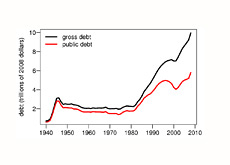


graph showing the growing debt of united states - who is buying all this debt?

How is the United States able to borrow trillions upon trillions of dollars?

Who is lending them all of this money?

These are some of the most common questions that I receive by email on this site, so I thought that I would devote an entire post to the topic.

As you are probably well aware, the United States has decided that the best way to tackle the problems of a collapsing economy and crumbling banking system is to throw money at it. Trillions upon trillions of dollars.

This is on top of the trillions upon trillions of dollars that the US government already owes in outstanding debt. As of this second, the total US national debt is around $11.17 trillion dollars. For an up to the second accounting of the total US national debt, you can visit our U.S. National Debt Clock page.

This number is expected to continue to spike over the coming years.

The Congressional Budget Office recently released a report in which they claimed that the total debt could reach $17.2 trillion dollars by 2019.

This is obviously a staggering sum of money.

What's more incredible is the amount of money that the US government (and by extension, the citizens of the United States) pay every year to service this debt. Hundreds of billions of dollars is paid out every year to service the ever-growing US debt load. Paying interest on debt is one of the biggest expenses of the US government, and this number will just continue to grow as the debt load grows.

Ok - so we have trillions of dollars being added to the US debt load every year.

Who is buying all of this debt?

And why are they buying it?

There are many different entities that purchase US debt.

Mutual funds. Foreign governments. Individual investors. Pension funds. The Federal Reserve. Hedge funds.

China itself owns around $739 billion dollars of US debt.

Japan owns around $635 billion dollars worth, while a number of other countries (including the UK, Brazil and Russia) all hold $100 billion dollar plus positions in US debt.

Heck, the Federal Reserve just announced their intentions to purchase $1.2 trillion dollars worth of government bonds and mortgage-related securities in an effort to lower borrowing costs.

That's right - the Federal Reserve is buying US debt. How are they paying for it? They are simply printing money. Just adding a few zeroes to their electronic ledger.

Anyways, these are the entities that currently own the $11 trillion dollars plus of US debt.

Now, the answer to the second question.

Why is there such a large demand for US debt?

Why have countries such as China, the UK and Russia significantly added to their holdings over the last number of years?

The main reason - US government debt is still considered to be the safest, most liquid investment in the world.

If you are a foreign government and need to park $50 billion dollars somewhere, where are you going to put it if you have zero tolerance for risk?

Currencies? No way.

Commodities? You could buy gold and oil, but you might lose money on your investment.

Stocks? Not a chance.

Real estate? Much too illiquid and volatile.

Debt of other nations? Which country has a more insatiable appetite for taking on debt than the United States? The answer? No one.

If you want to park money in an ultra-liquid and "safe" investment, then you choose US debt.

Why else would US treasury security issues constantly be oversubscribed, even though they will yield little to no returns? Investors (including foreign governments) are more interested in preserving capital at this point.

Will foreign governments, individual investors and the like ever lose their appetite for US debt issues?

It's a possibility. This would represent a doomsday scenario for the US government, and would likely result in massive inflation (assuming that the Fed would simply print money to purchase treasury issues).

With trillions of dollars in deficits expected over the next couple of years, the US debt load will continue to spike higher.

Will there ever come a day when the United States begins to pay off their massive debt load, or will they perpetually rely on debt issues in order to pay for their deficits?


Filed under: Stock Market Education



2 COMMENTS - What Say You?

Comment by Kelly Schild on May 06, 2009 @ 1:30 pm

Why does the US borrow from other countries when it can just sell more bonds to the Federal Reserve? Why do they even borrow from other countries when they can just basically print there own money??? It doesn't make sense to me. Can you explain this?

--

Comment by Will on August 02, 2009 @ 11:47 am

To answer Kelly: Inflation.
If the Federal Reserve buys US debt, it must pay in US dollars, to do so, it will print money. When you print money, it makes money more avaliable, and the more avaliable it is, the less it becomes worth. So if a country recklessly prints money (like Zimbabwe did a couple of years back) domestic prices will skyrocket.


--

Leave a Reply

Name:


Web Site:


Your Comment:


Related Articles

Posted on: 2010-09-02 14:00:00
Unemployment Rate Ticks Higher to 9.6% In August
BP Company Logo
Posted on: 2010-09-01 15:56:00
Institutional Investors Snapped Up Shares of BP During The Second Quarter
Illustration of a scroll
Posted on: 2010-08-31 20:34:00
More Than 10% of FDIC-Insured Institutions on Problem Bank List in Q2
Yahoo 5 year chart - August 30th, 2010 - YHOO
Posted on: 2010-08-30 11:56:00
Institutional Investors Continue To Be Indifferent Towards Yahoo!
Birth Rate on the Decline - Illustration
Posted on: 2010-08-27 19:28:00
US Birth Rate Continues To Tumble Thanks to Recession


Twitter

274


Dow Jones10447.93+127.831.22%
Nasdaq2233.75+33.741.51%
S&P 5001104.51+14.411.3%

The Manuel Fund Report Q2 Manuel
Fund Report

SPECIAL FEATURES

Q2/2010 Manuel Fund Report

United States Debt Clock

Where Did The DJIA/NASDAQ/S&P 500 Trade On..

Historical GDP Numbers for the United States

Recent SEC Hedge Fund Filings

Recent SEC Filings From Market Movers

US Government Spending Breakdown 1962-2015

History of Deficits and Surpluses in the U.S.

Inflation Calculator

Historical Unemployment Rates in the United States

Historical State Unemployment Rates

Canada Debt Clock

UK National Debt Clock

A History of Bank Failures in the United States

Mortgage Refinancing Calculator

Dow Jones Historical Data

Nasdaq Historical Data

S&P 500 Historical Data

Stock Market Guru Twitter Alerts

Historical Gold Prices

Median Household Income History

State Population Trends Since 2000


ANSWERS

Which US Stocks Have the Largest Market Caps?

Is Trading Forex Easy or Hard?

When Will the Apple iPad Launch in Canada?

What is the Difference Between the Kindle DX and the Kindle 2?

What is a Credit Default Swap?

Which Holidays Result in US Markets Being Closed For The Day?

Why Do Stocks Get Halted?

What is the Difference Between Level 1, Level 2 and Level 3 Assets?


BLOG POSTINGS

Microsoft Received Significant Interest From Institutional Investors During Q2

The Largest Holdings That Duquesne Capital Management LLC Will Have To Sell Are..

Q2 Hedge Fund Report Out This Weekend

The Bill and Melinda Gates Foundation Trust Bought Three New Stocks Last Quarter - What Were They?

Apple Sells 3.27 Million iPads in Q3

Big Day For Tesla As The Company Finally Goes Public

Nevada Now Leads Nation With 14.0% Unemployment

Chinacast Education (CAST) Popular With Institutional Investors Last Quarter

Renaissance Technologies LLC Q1/2010 13F-HR Report

Internet Melts Down Along With the Markets


FUND HOLDINGS

TWO SIGMA INVESTMENTS LLC

GREENLIGHT CAPITAL INC

RENAISSANCE TECHNOLOGIES LLC

BLUE RIDGE CAPITAL HOLDINGS LLC/BLUE RIDGE CAPITAL

SHUMWAY CAPITAL PARTNERS LLC

GOLDMAN SACHS GROUP INC

DUQUESNE CAPITAL MANAGEMENT L L C

ICAHN CAPITAL LP

SAC Capital Advisors LP

SOROS FUND MANAGEMENT LLC


MOST RECENT DICTIONARY ENTRIES

Currency Devaluation

Biflation

Hardship Withdrawal

Assets Under Management (AUM)

Passive Income

Trade Balance

Dovish

Permabull

Order Imbalance

Compounding


CREDIT CARDS AND OTHER SERVICES

The Top Three Online Stock Brokers In Canada

Jim Cramer Action Alerts Plus Review

Direct Access Brokers: The Best of the Best

Questrade Promotional Code - Qualifying for Your Free Commissions

The Top Two Forex Brokers in Canada

Hulbert Interactive Review

Marketwatch Options Trader Newsletter Review

Retirement Weekly Newsletter Review

Barron's Online Review

Wall Street Journal Subscription - Up to 80% Off Regular Price

Wall Street Journal Subscription Discount

Barron's Subscription Discount - Over 40% Off The Newsstand Price

Barron's Coupon Code

Financial Newspaper Discounts

Buy Gold American Eagles


ONLINE TRADING ACADEMY

How Forex Trades Work

Who Are The Best Online Brokers?

My Favorite Canadian Forex Brokers

Online Stock Brokers For Beginners

How to Trade Commodities Online

Forex For Beginners

Forex Reviews: A Couple of Forex Brokers That You Need to Check Out

Forex Brokers: What You Need to Know

Forex Bonus - How to Qualify For Your Free Forex Money


INTERNATIONAL CONTENT

Comment Acheter un Amazon Kindle en France

Wie kaufe ich einen Amazon Kindle in Deutschland

Como Comprar um Kindle da Amazon no Brasil


PROMOTIONS AND OFFERS

Where to Buy a Kindle in the UK

Kindle 3 Review

Where To Buy a Kindle?

WSJ Subscription Discount - Up to 80% Off

How to Buy an Amazon Kindle in Canada

Amazon Kindle Canada Review

Hercule Poirot DVD Reviews


ARTICLE ARCHIVES

Blog Posts

Company Reviews

Daytrading

General Knowledge

General Market News

Health + Fitness

Hedge Fund News

Internet Companies

Making Money Online

Motivational

Online Forex Trading

Real Estate News

Stock Market Education

Stock Market Scandals

The Economic Meltdown

Trader Profiles


DaveManuel.com - Copyright 2010, All Rights Reserved | Advertise | Privacy Policy | Disclaimer