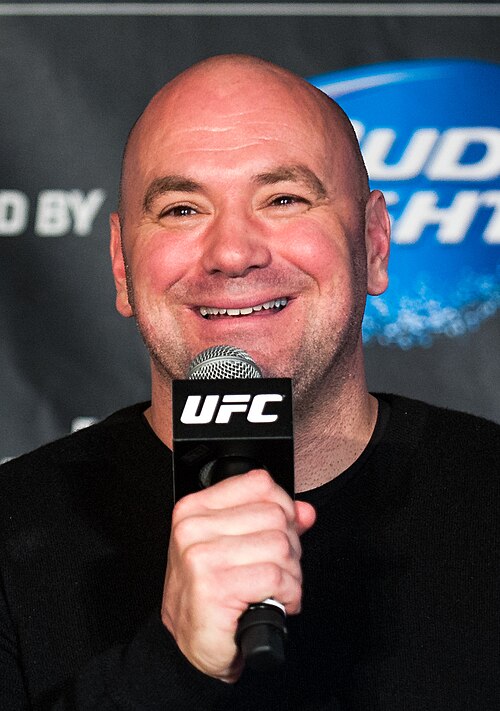
Dana White
01Overview
Dana White is worth an estimated $514 million, within a range of $440 million to $600 million. Most of it traces back to a single payday: the 2016 sale of the UFC, which was reported to be worth about $360 million to him before tax3 for the roughly 9% stake he was given when he helped the Fertitta brothers buy the company for $2 million in 2001.
Since then his fortune has grown through ten years of executive pay, TKO and Meta stock, a Las Vegas estate, and early bets such as Power Slap. Every value on this page is an estimate: White's pay and most of his private holdings are not publicly disclosed.
| Born | July 28, 1969, Manchester, Connecticut (age 57) |
| Residence | Las Vegas, Nevada |
| Source of wealth | 2016 UFC sale, executive pay |
| Current role | CEO and President of the UFC, part of TKO Group Holdings; Meta Platforms director |
| Largest holding | Liquid capital and equities |
02Reconcile the Estimate
Every holding we count, with its basis. White's pay, his 2016 proceeds and most of his private holdings are not disclosed, so nearly every line is our estimate. The rows add up to the headline figure.
| Counted | Basis | Value |
|---|---|---|
| Liquid capital and equitiesModeled | 2016 UFC sale, reported at about $360M before tax3 (an estimated $274M after 23.8% federal tax), plus ten years of undisclosed executive pay, investment returns and TKO and Meta stock4 | $450.0M |
| Power Slap (Schiaffo, LLC)Modeled | About 25% assumed, as one of four roughly $1M seed investors; carried at $75M against White's own, unverified $750M valuation1 | $75.0M |
| Tournament Hills compound, Las VegasEstimated | Four lots bought for about $8.15M in total (Las Vegas Review-Journal), plus construction and comparable estate sales | $50.0M |
| Howler Head whiskeyModeled | Brand sold to Infinium Spirits in March 2025; his equity and proceeds are undisclosed | $7.5M |
| Automobile collectionEstimated | Reported cars, including a '71 Barracuda, Ferrari Testarossa and F430, Lamborghini and '69 Bronco | $7.0M |
| Art and collectiblesEstimated | 16th-century samurai swords, rare sneakers | $4.0M |
| Maine real estateEstimated | Property in Levant, Maine | $3.0M |
| Thrill One Sports & EntertainmentModeled | Co-investment; the parent filed Chapter 11 on September 28, 2025 | $0 |
| Less: allowance for spending and illiquidityModeled | Our allowance for spending not captured in the asset values and for the difficulty of selling private holdings. It is not a disclosed debt2 | ($83.0M) |
| Estimated net worth | $514M | |
| Left out | Why | Value |
|---|---|---|
| Private aircraft | No aircraft is publicly confirmed in his name | Not counted |
| Zuffa Boxing | The TKO-Sela venture he leads; no personal stake is disclosed | Not counted |
| Unvested Meta stock awards | Restricted stock units from his Meta director grants that have not vested4 | Not counted |
No line uses a market price: his only disclosed public-company holding, a small number of Meta shares from director awards, is too small to move the figure; the roughly 900 vested Meta shares (under $1 million) sit inside the modeled liquid capital line. Values as of October 19, 2026.
Not observable: his actual 2016 proceeds; his UFC and TKO pay and any TKO stock (he files no ownership reports for TKO); his real stake in Power Slap and what it is worth; his gambling results; and any personal debt.
03Published Estimates
| Source | Date | Estimate |
|---|---|---|
| DaveManuel.com | October 2026 | $514M (range $440-600M) |
| Forbes5 | February 2025 | More than $600M |
Forbes has not published a breakdown of its figure, so we cannot say exactly why ours is lower. Two of our choices pull our estimate down: we value his Power Slap stake at $75 million rather than an even one-quarter share of White's own $750 million claim (about $188 million), and we subtract an $83 million allowance for spending and illiquidity.
04Assets and Liabilities
White's wealth was primarily generated through his stake in the UFC during the Zuffa era (reported as 9% at the 2016 sale), which was reported to be worth about $360 million to him before taxes3 (an estimated $274 million after federal capital gains tax, if that figure is right). His actual proceeds were never disclosed. His portfolio today includes liquid capital and public equities, private ventures, luxury real estate and collectibles.
| Asset | Value |
|---|---|
| Liquid capital and equities2016 UFC sale proceeds (est. $274M after tax), ten years of executive income, investment returns, and TKO and Meta equity | $450.0M |
| Power Slap (Schiaffo, LLC)One of four ~$1M seed investors (stake undisclosed, ~25% assumed); White claims a $750M valuation (self-reported, unverified) | $75.0M |
| Tournament Hills compoundLas Vegas estate assembled from four neighbouring lots bought for ~$8.15M in total (Las Vegas Review-Journal); current value estimated | $50.0M |
| Howler Head whiskeyBrand partnership proceeds; Infinium Spirits bought the brand from Monkey Spirit, LLC in March 2025 (White's equity undisclosed) | $7.5M |
| Automobile collection'71 Barracuda, Ferrari Testarossa, Ferrari F430, Lamborghini, '69 Bronco, Rolls-Royce and more | $7.0M |
| Art and collectibles16th-century samurai swords, rare sneakers | $4.0M |
| Maine real estateProperty in Levant, Maine, including the street where his grandparents lived | $3.0M |
| Thrill One Sports & EntertainmentCo-investment (Nitro Circus, Street League); parent filed Chapter 11 on September 28, 2025 | $0 |
| Total assets | $596.5M |
| Less: allowance for spending and illiquidity (modeled)2Our allowance for spending not captured in the asset values and for the difficulty of selling private holdings. No debts are publicly disclosed | ($83.0M) |
| Estimated net worth | $513.5M |
05Current Positions
| Organization | Role |
|---|---|
| Ultimate Fighting Championship (UFC) | Chief Executive Officer and President |
| TKO Group Holdings (NYSE: TKO) | CEO of the UFC division |
| Meta Platforms Inc. | Board of DirectorsDirector since December 30, 2024 |
| Power Slap (Schiaffo, LLC) | Co-founder and investor |
| Zuffa Boxing | Leads the TKO-Sela boxing ventureNo personal stake disclosed |
| Phorm Energy | PartnerWith 1st Phorm and Anheuser-Busch |
| Thrill One Sports & Entertainment | Co-investorParent filed Chapter 11 in 2025 |
06How the Fortune Was Built
| 1969 | Born July 28 in Manchester, Connecticut. | |
| 1992 | Founds Dana White Enterprises and begins managing Tito Ortiz and Chuck Liddell. | |
| 2001 | Persuades Lorenzo and Frank Fertitta to buy the UFC. Named president of Zuffa LLC with a 10% stake. | $2M deal |
| 2005 | The Ultimate Fighter debuts on Spike TV and takes MMA mainstream. | |
| 2016 | WME-IMG, Silver Lake and KKR buy the UFC for $4.025 billion. His stake, reported as 9%, is sold. | ~$360M reported |
| 2023 | UFC and WWE merge into TKO Group Holdings. Power Slap launches. | |
| 2025 | Joins Meta's board. UFC signs a $7.7 billion Paramount deal. Zuffa Boxing announced. | |
| 2026 | UFC Freedom 250 staged on the South Lawn of the White House. | $514M |
07Background
Early Life and Fighter Management
Born in Manchester, Connecticut, Dana White grew up in a working-class family. His mother, a nurse, moved the family to Las Vegas when White was in third grade, seeking higher wages. He attended Bishop Gorman High School, where he first met future business partner Lorenzo Fertitta. White later moved to Maine, graduating from Hermon High School in 1987, and briefly attended Quincy College and UMass Boston without finishing a degree. He spent his summers in Levant, Maine with his grandparents, a connection he maintains to this day. After returning to Las Vegas, White established Dana White Enterprises in 1992 and began managing MMA fighters Tito Ortiz and Chuck Liddell. This early experience in combat sports management would prove instrumental to his future success, teaching him the economics of fight promotion and athlete representation.
The $2 Million Acquisition That Changed Everything (2001)
In 2001, the mixed martial arts landscape was fractured and stigmatized. The Ultimate Fighting Championship, owned by Semaphore Entertainment Group, was facing bankruptcy and banned in most states. White identified an extraordinary opportunity and convinced childhood friends Lorenzo and Frank Fertitta III - casino magnates with deep political connections - to acquire the UFC for just $2 million.
The critical detail that would define White's fortune: he wasn't hired as a mere employee. White was installed as President of the newly formed holding company, Zuffa LLC, and given a 10% equity stake (reported as 9% by the time of the 2016 sale). This "sweat equity" structure meant his primary wealth vehicle was illiquid stock in a private company. For the next 15 years, White's compensation was relatively modest compared to the enterprise value he was building, aligning his interests completely with the Fertitta brothers and driving aggressive expansion.
Building the Empire: From Pariah to Powerhouse (2001-2016)
White's strategy was multifaceted and aggressive. He acquired rival promotions - PRIDE, Strikeforce and WEC - consolidating the fragmented MMA landscape. He personally lobbied state athletic commissions to regulate and legalize mixed martial arts, transforming the sport from "human cockfighting" into a sanctioned athletic competition. The launch of The Ultimate Fighter reality show on Spike TV in 2005 proved to be the watershed moment, introducing millions of cable viewers to MMA and creating mainstream stars like Forrest Griffin and Rashad Evans.
During this period, White operated with a focus on long-term capital appreciation over short-term income. His compensation was modest by sports executive standards, but his equity stake was growing in value exponentially as the UFC's enterprise value climbed from $2 million to over $4 billion.
The Reported $360 Million Payday (2016)
In July 2016, the Fertitta brothers sold the UFC to a consortium led by WME-IMG (now Endeavor), Silver Lake Partners and KKR for $4.025 billion - the largest transaction in sports history at that time. ESPN reported, citing sources, that White owned 9% of the UFC, "which would mean he'd be receiving roughly $360 million"3. His actual proceeds were never disclosed, and 9% of the headline price is not necessarily 9% of the equity after the company's debt. If the $360 million figure is right, federal capital gains tax (20%) and the Net Investment Income Tax (3.8%) would have left him about $274 million.
Unlike the Fertitta brothers, who exited operationally, White was viewed as a "key man" essential to the brand. He signed a contract to remain as President that, according to ESPN, included 9% of the UFC's net profits, allowing him to convert paper wealth to cash while keeping a high-income executive role.
The TKO Era: Public Company CEO (2023 Onward)
In September 2023, Endeavor merged the UFC and World Wrestling Entertainment (WWE) to form TKO Group Holdings, which trades on the New York Stock Exchange (NYSE: TKO). White moved from UFC President to Chief Executive Officer of the UFC division within the new public company. In December 2025, White said he had signed another five-year extension earlier that year; the terms and end date were not released.
The extension followed the UFC's $7.7 billion, seven-year media rights deal with Paramount, announced in August 2025 and running from January 2026. It moved every numbered UFC event to Paramount+, with some cards on CBS, and ended US pay-per-view. Paramount pays an average of about $1.1 billion a year, weighted toward the later years. White is not one of the named executive officers in TKO's proxy, so his pay is not publicly disclosed; it is commonly estimated at around $20 million a year, from salary, profit participation and TKO equity awards.
Power Slap: The Speculative Bet
Perhaps White's most controversial and potentially lucrative venture is Power Slap, a professional slap fighting league. Co-founded through Schiaffo, LLC, with about $1 million of seed money each from White, Lorenzo Fertitta, Frank Fertitta and producer Craig Piligian, Power Slap has grown in value according to White's own claims: $450 million in late 2023, and later $750 million. These figures are entirely self-reported by White and have not been independently verified. Forbes estimated the league's 2024 revenue at about $50 million. Power Slap has staged events in Riyadh and Abu Dhabi and moved its content from Rumble to YouTube, though concerns about athlete safety and brain trauma persist.
White's ownership stake has not been publicly disclosed. With four roughly equal seed investors, an even split would give him about a quarter, though the actual terms are private. White uses UFC events and facilities to promote and stage Power Slap, running commercials during UFC broadcasts and holding Power Slap competitions at the UFC's Las Vegas facility (renamed the Meta Apex in January 2026).
Additional Ventures: Thrill One and Howler Head
In 2022, White co-invested in the $300 million acquisition of Thrill One Sports & Entertainment, the parent company of Nitro Circus and Street League Skateboarding. This private equity position alongside Fiume Capital and Juggernaut Capital was initially valued at $10-20 million. However, the parent entity, Thrill Intermediate LLC, filed for Chapter 11 bankruptcy in the District of Nevada on September 28, 2025, after lenders declared defaults and moved to take control, making White's co-investment likely worth little or nothing.
White also partnered on Howler Head Whiskey, a banana-flavored bourbon where he served as the brand's public face. Campari Group acquired a 15% stake in the brand (for $15 million) and distribution rights in 2022. In March 2025, Infinium Spirits acquired Howler Head from Monkey Spirit, LLC for an undisclosed sum, buying out all stakes including Campari's. White's specific equity interest in Monkey Spirit, LLC is not publicly documented, though his role as the brand's primary ambassador suggests he received compensation from the transaction.
Meta Board of Directors (2025)
Meta's board elected Dana White as a director effective December 30, 2024, and the appointment was announced on January 6, 2025. His initial grant was 1,999 restricted stock units4, worth about $1.28 million when reported (Sportico). The relationship has since extended to the UFC itself: Meta bought the naming rights to the UFC's Las Vegas production facility, now the Meta Apex.
Zuffa Boxing and Phorm Energy (2025)
In 2025, White announced Zuffa Boxing, a joint venture of TKO and the Saudi entertainment company Sela, backed by Turki Al-Sheikh, head of Saudi Arabia's General Entertainment Authority. TKO is the managing partner and White leads the venture, though he has no disclosed personal stake. Its first event was Canelo Alvarez vs. Terence Crawford in September 2025, and its regular series began on Paramount+ on January 23, 2026. White had long circled the boxing world (co-promoting Mayweather vs. McGregor in 2017) and said he was "coming in guns blazing" to fix what he called a "broken business." In May 2025, White also partnered with 1st Phorm and Anheuser-Busch on Phorm Energy, a zero-sugar energy drink, adding to his consumer brand ventures.
2026: The White House Card
On June 14, 2026, the UFC staged UFC Freedom 250 on the South Lawn of the White House, where Justin Gaethje upset Ilia Topuria for the lightweight title. TKO said it lost about $30 million on the event. Earlier in the year, White testified in the Johnson v. Zuffa antitrust case over fighter pay; a separate $375 million settlement of the Le v. Zuffa case received final approval in February 2025.
The "Whale" Lifestyle and Gambling Economics
White is a well-known "whale" in Las Vegas casinos. By his own account on the Full Send podcast, Caesars Palace lets him bet $350,000 a hand at baccarat, and he won about $26-27 million there from January to March 2024. He has also reportedly lost $8 million in a single night. This high-variance gambling introduces real liquidity risk - a bad streak can deplete cash reserves quickly - but it is offset by his income from UFC compensation and Meta board fees.
Paradoxically, his whale status brings millions of dollars in casino "comps" - including private jet travel on casino aircraft, penthouse suites and event hosting - effectively subsidizing his lifestyle. The casino pays for amenities he would otherwise buy, in exchange for his gambling action.
08Additional Comments
Dana White is a very polarizing figure. On one hand, the UFC doesn't exist without White and his passion for the sport.
On the other hand, many people (including numerous fighters) are upset with Dana White and the UFC when it comes to fighter pay.
In addition, Dana White and President Donald Trump are close friends, with White having spoken at numerous Trump campaign rally events.
Since the merger of UFC and WWE into TKO Group Holdings in 2023, White serves as the CEO of the UFC, though he has diversified his time and interest into other ventures as well, including Power Slap and Zuffa Boxing.
09Frequently Asked Questions
What is Dana White's net worth?
Dana White's net worth is estimated at about $514 million as of October 2026, within a range of $440 million to $600 million. Forbes has put him at more than $600 million.
How did Dana White make his money?
Mostly from the 2016 sale of the UFC for $4.025 billion, which was reported to be worth about $360 million to him before tax, for a stake reported as 9%. He has since earned an estimated $20 million a year as UFC chief executive, plus TKO and Meta stock.
Does Dana White own part of the UFC?
Not as far as is publicly known. His roughly 9% stake was reported sold in the 2016 deal; whether he kept any stake in the new company was not reported. The UFC is now part of TKO Group Holdings, a public company, and White runs it as CEO.
What is Power Slap worth?
Dana White has claimed a valuation of $750 million, but the figure is self-reported and unverified. His own stake is undisclosed; we assume about 25% and discount the valuation heavily.
10Sources and Method
This estimate uses a sum-of-the-parts method: each asset is valued separately from public records and reporting, then a modeled allowance for spending and illiquidity is subtracted. No debts are publicly disclosed, so nothing is subtracted as a liability. Almost every line is an estimate, because White's pay, his 2016 proceeds and his private stakes are not disclosed. The assets total $596.5 million; less the $83 million allowance, that gives $514 million.
Both ends of the range use the page's own line items. The low end, about $440 million, values his Power Slap stake at zero, since the only valuation is White's own. The high end, about $600 million, drops the $83 million allowance and keeps every asset at our value.
- 2016 sale: reported at about $360 million gross (est. $274M after tax) for his roughly 9% UFC stake in the sale to the WME-IMG/Endeavor consortium; ESPN, July 12, 2016 (ABC7). His actual proceeds were never disclosed.
- Executive pay (2016 onward): estimated at about $20 million a year from UFC/TKO, including salary, profit participation and TKO equity awards. White is not a named executive officer in TKO's proxy, so the figure is not disclosed.
- Meta board pay: initial grant of 1,999 restricted stock units (about $1.28 million when reported, Sportico), plus ongoing director pay.
- Private valuations: Power Slap valued at $750M per White's own claims (unverified), discounted heavily; ~25% stake assumed from four equal seed investors.
- Real estate: Tournament Hills compound valued at $50M based on lot purchases (Las Vegas Review-Journal), custom construction and comparable Las Vegas estate sales.
- Luxury assets: automobile collection ($6-8M) and collectibles ($3-5M). Private aviation is excluded because no aircraft is publicly confirmed in his name.
- Key risks: high-stakes gambling adds liquidity volatility; the Power Slap valuation is self-reported; TKO equity holdings for division executives are not disclosed in SEC filings.
1 DaveManuel.com estimate. White's stake in Schiaffo, LLC is not public.
2 DaveManuel.com estimate. It is a modeled allowance, not a disclosed debt.
3 ESPN, July 12, 2016, republished by ABC7: sources said White owned 9% of the UFC, "which would mean he'd be receiving roughly $360 million." The same report said it was not known whether he kept any stake in the new company. The figure is media arithmetic, not a disclosed amount.
4 Meta Form 4 for White dated January 17, 2025: two awards totalling 1,999 restricted stock units (247 vesting May 15, 2025; 1,752 vesting quarterly over four years from May 2025) (SEC). White files no ownership reports for TKO.
5 Forbes Australia, February 7, 2025: "a net worth that Forbes estimates to be more than $600 million" (Forbes).
Last updated: October 19, 2026. Net worth figures are estimates built from public filings and reporting; private holdings are valued conservatively and may differ from what the person would report.
Cite This Page
This page is free to cite and link. Please include the date you accessed it.
| Format | Citation | Copy |
|---|---|---|
| Plain | Dave Manuel, “Dana White Net Worth,” DaveManuel.com, updated October 19, 2026, https://www.davemanuel.com/net-worths/dana-white/ (accessed October 26, 2026). | Copy |
| APA | Manuel, D. (2026). Dana White Net Worth. DaveManuel.com. Retrieved October 26, 2026, from https://www.davemanuel.com/net-worths/dana-white/ | Copy |
| Chicago | Manuel, Dave. “Dana White Net Worth.” DaveManuel.com. Accessed October 26, 2026. https://www.davemanuel.com/net-worths/dana-white/. | Copy |
| Wikipedia | {{cite web |url=https://www.davemanuel.com/net-worths/dana-white/ |title=Dana White Net Worth |last=Manuel |first=Dave |website=DaveManuel.com |access-date=2026-10-26}} | Copy |
| Link (HTML) | <a href="https://www.davemanuel.com/net-worths/dana-white/">Dana White Net Worth (DaveManuel.com)</a> | Copy |
Page last updated October 19, 2026. How we build our data pages.