Every Time the Insurrection Act Has Been Used
 The Insurrection Act of 1807 has always been one of the most powerful, least-used tools in the U.S. President's arsenal. It allows the Commander-in-Chief to deploy federal troops within the United States to suppress civil disorder, insurrection, or rebellion. It effectively lets the federal government override state authority in moments of crisis.
The Act traces back to a period of political unrest. Thomas Jefferson signed it into law after Congress passed it in response to conflicts on the western frontier and concerns over domestic uprisings. The goal was simple: provide a legal pathway for using military force to restore order when local authorities could not.
Over time, the Insurrection Act has been invoked only sparingly - and usually under extreme circumstances.
One of the earliest uses came in 1808, when federal troops were deployed to enforce an embargo against British trade. It reappeared during the early 19th century when President Andrew Jackson used federal power to suppress South Carolina's attempt to nullify federal tariffs in 1833. That moment became a defining test of federal versus state power.
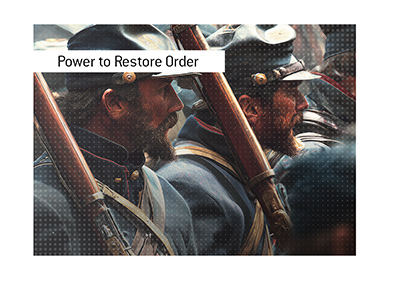
The Civil War era brought more direct use. President Abraham Lincoln invoked the Act in 1861 to suppress the Confederate rebellion. Federal troops were mobilized to restore federal authority, marking the most sweeping application of the Act in U.S. history.
After the war, Presidents used it periodically to enforce Reconstruction laws. Federal troops intervened in southern states to protect newly freed Black citizens and uphold federal court orders - most notably under Ulysses S. Grant, who used it to combat the Ku Klux Klan in South Carolina in 1871.
In the 20th century, the Act's use shifted toward civil rights and large-scale riots. President Dwight Eisenhower invoked it in 1957 to enforce desegregation at Little Rock Central High School. The image of federal troops escorting the Little Rock Nine became one of the defining moments of the Civil Rights era.
John F. Kennedy and Lyndon Johnson would use the Act again in the 1960s to enforce desegregation orders and restore order in cities gripped by riots. In 1962, Kennedy sent troops to the University of Mississippi to ensure James Meredith could enroll. Johnson later invoked it during the Detroit riots of 1967, sending the 82nd and 101st Airborne Divisions to restore order.
In 1989, President George H.W. Bush invoked the Insurrection Act during the Los Angeles riots of 1992 after the acquittal of police officers in the Rodney King case led to widespread violence. It was the last time the Act was formally used.
Since then, the Insurrection Act has hovered in the background of American politics. It was discussed after Hurricane Katrina in 2005, though not invoked. It resurfaced in public debate in 2020 amid nationwide protests and unrest. While no president has signed the order since 1992, the authority remains fully intact - a reminder of the federal government's ultimate power to restore order.
The Insurrection Act remains one of the most controversial tools in U.S. law - powerful, legal, and rarely touched. Presidents are always aware it exists. The public tends to remember it only when the nation feels close to crisis.
Filed under: General Knowledge