Strategic Petroleum Reserve Was Officially Established in Late 1975
 It was the mid 1970s, and the United States had a big problem.
During the Yom Kippur War, members of the Organization of Arab Petroleum Exporting Countries imposed an oil embargo against the United States. The embargo was in retaliation for America's support of Israel in the conflict.
The embargo had disastrous consequences, causing a quadrupling in oil prices. The United States realized how vulnerable they were to an oil shock, and they made moves to lessen the future impact via the Energy Policy and Conservation Act (EPCA), which was signed into law in late 1975 by Gerald Ford.
This Act established the Strategic Petroleum Reserve (SPR). By purchasing hundreds of millions of barrels of oil and stashing them around the country, the United States would be able to better protect itself against future spikes on oil.
As of the week ending September 25, 2026, the US Strategic Petroleum Reserve sits at 283.8 million barrels. That is just under 40% of its 714 million barrel authorized capacity, and the lowest level the reserve has held in roughly 44 years.
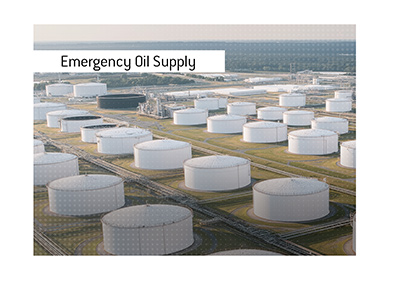
The oil in the Strategic Petroleum Reserve is kept in four locations - Bryan Mound (Brazoria County, Texas), Big Hill (Jefferson County, Texas), West Hackberry (Cameron Parish, Louisiana) and Bayou Choctaw (Iberville Parish, Louisiana).
The oil is stored in heavily guarded, underground salt caverns along the coast of the Gulf of Mexico. The caverns are connected to commercial pipelines and refineries, which is why the oil is stored in those particular locations.
Peak inventory levels for the US SPR was hit in December of 2009. At that point, the US was actually over capacity, and had 726.6 million barrels of oil in its reserves.
Oil was released at strategic times over the years in order to try and manage prices. Oil, for instance, was released from the SPR before the Gulf War in 1990 and after Hurricane Katrina.
There was a massive 180 million barrel drawdown in 2022, due to the war between Russia and Ukraine, as the United States tried to stabilize oil prices throughout the world. That one took the reserve down to 351.8 million barrels by the summer of 2023, which was a 40 year low at the time.
Refilling began after that, and by the early part of 2026 the reserve had climbed back to roughly 415 million barrels. Then the Strait of Hormuz closed.
On March 11, 2026, President Trump authorized the Department of Energy to release 172 million barrels over approximately 120 days. This was the American contribution to a coordinated 400 million barrel release by International Energy Agency member nations, and it is the reason the reserve has fallen by around 125 million barrels since the spring. Two enormous drawdowns in four years, and the SPR never got back to full in between them.
There is an important difference between the 2022 drawdown and this one, and most coverage skips it.
The 2022 action was a sale. The oil left federal ownership permanently in return for cash, and refilling it afterwards required Congress to appropriate money to buy barrels back on the open market. The 2026 release is being run as an exchange instead. Companies borrow the crude now and are contractually obligated to return it later, along with additional barrels as a premium.
The first tranche, awarded in March of 2026, sent out 45.2 million barrels and is contracted to bring back 55 million. Across the full program, roughly 172 million barrels go out and roughly 200 million are due back, on a return schedule running from late 2026 into 2028.
So on paper the reserve ends up larger than it started, at no cost to the taxpayer. The catch is timing. The barrels leave immediately and return over a period of years, and in the meantime the cushion is a lot thinner than it has been in decades. The Department of Energy has projected that the reserve will bottom out at around 243 million barrels once the entire commitment has been delivered.
For context, Congress set a statutory threshold of 252.4 million barrels, below which certain limited drawdowns are restricted. The reserve currently sits about 31 million barrels above that line. The 2026 release is being run through the DOE's exchange authority rather than the sale authority that the threshold governs, so it does not formally apply in this case - but it is the number worth keeping an eye on.
The separate figure that actually constrains things is the safe operating minimum. The DOE has put that at roughly 70 million barrels, which is the point at which the salt caverns themselves stop working properly. That is the real floor, and the reserve is nowhere near it.
Source: US Oil Reserves
Filed under: General Knowledge