The Bab el-Mandeb Strait and the Strait of Hormuz - The World's Two Most Dangerous Chokepoints
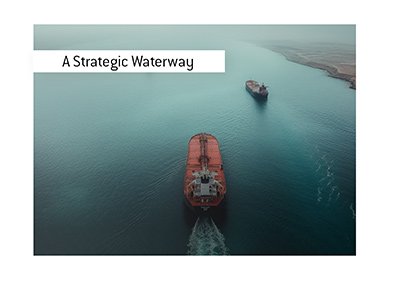 The Bab el-Mandeb Strait. Translation? "The Gate of Tears". "The Gate of Grief". "The Gate of Anguish". All are used, and all apply.
The Bab el-Mandeb Strait connects the Middle East with East Africa, and serves as a bridge between the Red Sea and Indian Ocean. The Strait sits between Yemen and Djibouti and Eritrea.
The Strait, which is roughly 18-20 miles wide at its narrowest point, is known for being difficult to navigate. The weather is terrible, underwater reefs are everywhere and the currents are hard to predict. The Strait has earned its name of "The Gate of Tears", as many sailors have died there.
Prior to 2023, over 9 million barrels of oil flowed through the Bab el-Mandeb Strait every day. Attacks from the Houthis, an Iranian-backed rebel group, dropped this total dramatically to its current level of 4.1 - 4.2 million barrels per day.
The Houthis are based in Yemen, which gives them access to the coastline along the Bab el-Mandeb Strait. The Houthis have been a thorn in the side of shipping companies, firing anti-ship ballistic missiles, deploying drones and lacing the Strait with mines.
Many companies have found the Strait too dangerous to sail through, and they have elected to sail all the way around the Cape of Good Hope.
While the Bab el-Mandeb Strait handles a fraction of the oil shipping that the Strait of Hormuz does, the ongoing attacks by the Houthis still has an impact on global oil prices.
Here's the part that doesn't get enough attention when people talk about Hormuz. The Strait of Hormuz handles roughly 21 million barrels of oil per day - around 20% of global consumption - and it's rightly treated as the most critical chokepoint in the world for energy supply. But Hormuz is only half the problem. The oil that exits the Persian Gulf through Hormuz still has to get somewhere, and a very large portion of it - crude headed for European and Mediterranean markets - then has to pass through the Bab el-Mandeb Strait as well. These aren't two separate risks sitting in two separate corners of the world. They're sequential gates on the same route, and right now both of them are under pressure at the same time.
Hormuz is carrying the usual Iranian threat backdrop, which has been elevated by the broader regional tension of the past two years. The Bab el-Mandeb is in active, sustained disruption - throughput down more than 50% from pre-conflict levels, Suez Canal revenues down roughly 60% through mid-2024, and major shipping companies rerouting entirely around the Cape of Good Hope, absorbing 10 to 14 extra days of sailing time per voyage just to avoid the problem.
The Saudi East-West Pipeline gets brought up a lot as the answer to Hormuz risk. It runs from Saudi Arabia's Eastern Province to the Red Sea port of Yanbu, with a capacity ceiling of roughly 5 million barrels per day, which means Saudi crude can reach the Red Sea without going through the Gulf at all. That sounds useful until you look at it closely. The pipeline serves Saudi production only - it does nothing for Iraqi, Kuwaiti, or UAE producers who also need to move their volumes. And the pipeline terminates at Yanbu, on the Red Sea. From there the crude still has to move through the Bab el-Mandeb to reach European markets. An oil barrel that sidesteps Hormuz via the East-West Pipeline arrives directly at the entrance to the other disrupted chokepoint. It's a partial solution that routes the problem, not around it.
The financial data from 2024 puts a number on what this dual pressure looks like in practice. War risk insurance premiums for Red Sea transits increased by multiples. Marine insurers formally reclassified the Red Sea as an active war risk zone, which cascades through hull, cargo, and P&I club coverage simultaneously. Added insurance costs per voyage were running from several hundred thousand dollars to over $1 million depending on vessel type. Put that alongside $1 million to $2 million in added bunker fuel for the Cape of Good Hope reroute, and the cost of moving Persian Gulf crude to European markets has been structurally repriced from both ends of the corridor at once.
The Gate of Tears has been earning that name since long before anyone invented the supertanker. Right now it's doing so again - and this time, it's pulling the Strait of Hormuz into the same conversation.
Filed under: General Knowledge