How Three Words In A Truth Social Post Reset The 60-Day War Powers Clock
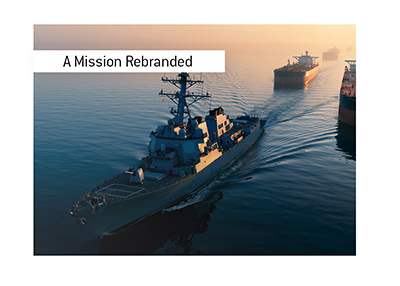 On Friday, May 1, 2026 - the day the 60-day War Powers Resolution clock was set to expire on the war with Iran - President Trump sent a letter to Congress declaring that the hostilities that began on February 28 had terminated. Two days later, with the U.S. naval blockade of Iran still in place, Trump announced "Project Freedom," a humanitarian operation in which 15,000 American service members, more than 100 aircraft, and a fleet of guided-missile destroyers would guide neutral commercial ships out of the Strait of Hormuz beginning Monday, May 4. Critics call it a legal workaround. Defenders call it the most strategically sophisticated move of Trump's second term. The two readings are not mutually exclusive.
How 'Project Freedom' Resets The War Powers Clock - And Why That May Be The Whole Point
In 72 hours, the Trump administration ended a war it never asked Congress to authorize, then started a new operation under a different name. The architecture is borrowed from Reagan, 1987.
On Friday, May 1, 2026 - the day the 60-day War Powers Resolution clock was set to expire on the war with Iran - President Trump sent a letter to Congress declaring that the hostilities that began on February 28 had terminated. Two days later, with the U.S. naval blockade of Iran still in place, Trump announced "Project Freedom," a humanitarian operation in which 15,000 American service members, more than 100 aircraft, and a fleet of guided-missile destroyers would guide neutral commercial ships out of the Strait of Hormuz beginning Monday, May 4. Critics call it a legal workaround. Defenders call it the most strategically sophisticated move of Trump's second term. The two readings are not mutually exclusive.
The Clock That Was Supposed To Stop The War
The War Powers Resolution of 1973 was Congress's answer to Vietnam. Its mechanism is simple. The President has 48 hours after introducing U.S. forces into "hostilities" to notify Congress in writing. From the date of that notification, a 60-day clock starts running. If Congress has not declared war or specifically authorized the use of military force within those 60 days, the operation must end. A 30-day extension is available, but only to safely withdraw forces - not to continue offensive operations.
U.S. and Israeli forces launched coordinated airstrikes against Iran on February 28, 2026, under the codename Operation Epic Fury. The campaign killed Iranian Supreme Leader Ali Khamenei, struck nuclear facilities and military installations, and triggered Iranian missile barrages against U.S. bases in Qatar, Bahrain, and the UAE. President Trump notified Congress on March 2, 2026. Sixty days later was May 1.
Congress did not vote to authorize the war. A war powers resolution introduced by Democrats failed repeatedly. Senate Majority Leader John Thune indicated he had no intention of bringing an authorization vote to the floor. Senator Susan Collins of Maine was the only Republican who broke ranks to vote with Democrats on a withdrawal resolution. So as the deadline approached, the administration faced a choice: end the war, get an authorization, ignore the law, or find a creative interpretation of the statute that would keep the operation legal without doing any of the above.
It chose the fourth option.
The Two-Step
The legal architecture has two moving parts and a third that depends entirely on Iran.
Step one was the May 1 letter. In nearly identical letters to House Speaker Mike Johnson and Senate President Pro Tempore Chuck Grassley, Trump wrote: "The hostilities that began on February 28, 2026 have terminated." The reasoning offered was that a ceasefire negotiated on April 7 had held - there had been no exchange of fire between U.S. and Iranian forces in three weeks - and that under the administration's reading of the statute, the absence of active fire meant the "hostilities" the WPR governs no longer existed. The 60-day clock therefore did not run out. It simply stopped having anything to count.
Defense Secretary Pete Hegseth had previewed this argument before the Senate Armed Services Committee the day before, telling lawmakers that under the administration's understanding the 60-day clock "pauses or stops" during a ceasefire. The argument is novel. Nothing in the text of the 1973 statute provides for the clock to pause. Katherine Yon Ebright, an attorney at the Brennan Center for Justice, has written that pausing the clock is "not something that by its text or design the War Powers Resolution accommodates." But novel does not mean inadmissible. The Office of Legal Counsel has, for half a century, made novel WPR interpretations that no subsequent administration has felt obligated to relitigate.
Step two was the May 3 announcement. Trump posted on Truth Social that the United States would launch "Project Freedom" on Monday morning, Middle East time. The framing throughout the announcement is the part that matters. The operation is described as a "humanitarian gesture." The vessels being aided are described as "neutral and innocent bystanders." The countries whose ships are stranded are described as "not in any way involved" in the conflict. The U.S. role is described as "guiding" them out, not escorting them through. CENTCOM characterized its support as a "defensive mission" aimed at restoring "freedom of navigation." The word "freedom" appears in the operation's name.
None of this language is accidental. Each phrase tracks closely to specific terms-of-art under the War Powers Resolution and customary international law. "Humanitarian" operations have historically been treated as not constituting "hostilities" for WPR purposes. "Defensive" force is permitted under both the WPR and the U.N. Charter. "Freedom of navigation" is a long-recognized principle that allows the U.S. Navy to operate in international waters without consent of the coastal state.
Step three is what happens if Iran fires. If Iranian forces interfere with Project Freedom, the administration's position will be that Iran started a new conflict, and that the U.S. response is defensive force in protection of an ongoing humanitarian mission. Under that framing, no new 60-day clock starts because the United States did not initiate hostilities. Iran did. The President can invoke his Article II constitutional authority to defend U.S. forces in the field, which has been recognized by every administration of either party since 1973 as not requiring congressional authorization.
The Reagan Precedent
The architecture is not new. It is, almost line for line, the legal posture the Reagan administration adopted in 1987 for what became Operation Earnest Will - the largest U.S. naval convoy operation since World War II, run in the same body of water, against the same adversary.
In late 1986, Iran was attacking Kuwaiti oil tankers as part of the Tanker War phase of the Iran-Iraq conflict. Kuwait asked the United States for protection. The Reagan administration, after weeks of internal debate, agreed in March 1987 to reflag eleven Kuwaiti tankers as American vessels, allowing the U.S. Navy to escort them through the Persian Gulf under the legal cover of protecting U.S.-flagged shipping. The State Department's Legal Adviser at the time argued that the protection of the vessels was meant to deter, not provoke, Iranian military action - and that the operation therefore did not constitute "hostilities" or "imminent hostilities" under the War Powers Resolution.
Congress disagreed. Members of both parties argued that escorting tankers in a war zone, with naval combatants embedded in the convoys and with rules of engagement that anticipated Iranian fire, manifestly constituted hostilities. The administration held its ground. After the USS Stark was hit by an Iraqi Exocet missile in May 1987 - 37 sailors killed - Secretary of State George Shultz sent the Speaker of the House what scholars would later call an "anti-War Powers report": a letter that explicitly denied U.S. forces were in hostilities or imminent hostilities, while not invoking the WPR at all.
Earnest Will ran from July 1987 through September 1988. During that fourteen-month window, U.S. forces fought multiple direct engagements with the Iranian military, including the sinking of three Iranian boats by Army special operations helicopters in September 1987, the destruction of the Rashadat oil platform in October 1987 in retaliation for an Iranian Silkworm missile strike on the reflagged tanker Sea Isle City, and Operation Praying Mantis in April 1988, which destroyed two Iranian oil platforms and sank or disabled three Iranian naval combatants and three small boats. None of it was ever submitted to Congress for authorization. None of it ever triggered the War Powers Resolution's 60-day clock. The legal architecture held.
Why The Critics Aren't Wrong, Either
The constitutional objections to this gambit are real and they are not new. Senator Susan Collins of Maine, breaking with her party in support of a war powers resolution, said the WPR's 60-day deadline is not a suggestion but a requirement. Senator Richard Blumenthal of Connecticut argued there is no pause button in the Constitution or the War Powers Act. Representative Adam Smith of Washington, the ranking Democrat on House Armed Services, said he had no expectation the administration would follow the law. None of these arguments is unreasonable. All of them are likely to be irrelevant.
The reason they will be irrelevant is that the War Powers Resolution has, in practice, never successfully been used to compel an unwilling president to end a military operation. Bill Clinton kept troops in Kosovo past the 60-day deadline in 1999 by arguing that congressional appropriations constituted authorization. Barack Obama argued in 2011 that the Libya bombing campaign did not rise to the level of "hostilities" under the WPR because no U.S. ground troops were involved. George H.W. Bush sought authorization for the 1991 Gulf War while explicitly stating he did not believe he needed it. Every administration of either party has taken the position that meaningful provisions of the WPR are unconstitutional. No federal court has ever ordered a president to comply with the 60-day clock.
What this means is that even if the Trump administration's pause-the-clock-during-ceasefire interpretation is wrong as a matter of statutory construction - and it almost certainly is - the practical consequence of that wrongness is approximately zero. Congress can pass a resolution. The President can veto it. Override requires two-thirds of both chambers, which has never happened on a war powers question. The lawsuit option requires standing, which courts have repeatedly found members of Congress lack on these matters. Hegseth has stated, in front of cameras, that the Pentagon is "locked and loaded" on Iranian power generation and energy infrastructure - language that would be hard to reconcile with a good-faith claim that hostilities have terminated. None of this matters legally if no court will hear the case.
The Two Readings, Side By Side
de-escalatory
the same war
What Iran Does Next Is The Whole Game
The legal architecture, however clever, only holds if the operation succeeds without Iran firing on it. If a Project Freedom convoy passes through the strait without incident on Monday, and another on Tuesday, and another on Wednesday, the legal framing becomes self-validating. The administration will be able to point to weeks of unimpeded humanitarian transit as proof that hostilities have indeed terminated and that the operation is what it claims to be.
If Iran fires on a U.S. warship escorting commercial vessels, or mines a shipping lane, or boards a civilian ship under U.S. protection - any of which it has done at various points since the conflict began - the legal architecture is harder to maintain but the political architecture becomes much easier. The President will respond with force, the response will be characterized as defensive, and a public already exhausted by two months of war will largely accept that whatever happens next is Iran's fault for breaking the peace. The 1987 precedent shows exactly how this plays out: USS Stark, Bridgeton mining, Sea Isle City missile strike, Operation Praying Mantis. Each engagement was framed as Iran starting it, the U.S. finishing it, and Congress having nothing to say.
The Bottom Line
In 72 hours, the Trump administration declared an undeclared war over, started a new military operation in the same theater against the same adversary, framed that operation in language that exempts it from the law that was supposed to constrain it, and put 15,000 American service members on the line of contact. The legal architecture is borrowed from a Reagan-era operation that ran for fourteen months, fought multiple direct engagements with Iranian forces, was never authorized by Congress, and never triggered the War Powers Resolution's 60-day clock. The architecture worked then. It is being deployed now in a much more constrained political environment, against a much more aggressive adversary, with a much larger force package, and against a Congress that has, so far, declined to test it.
Whether Project Freedom is a brilliant legal maneuver or just a new name for the same war is, at this exact moment, unfalsifiable. By Friday it may be either. The answer depends entirely on whether Iran fires on Monday morning. If it does not, the gambit becomes the most important precedent in War Powers Resolution jurisprudence since 1987, and the second time the same administration architecture will have been validated by Iranian inaction. If it does, the next 60-day clock will not start, the President will respond with force he has already said he is "locked and loaded" to deploy, and the question of whether the war ever actually ended on May 1 will become an academic one.
SOURCES & REFERENCES
- White House letters from President Donald J. Trump to House Speaker Mike Johnson and Senate President Pro Tempore Chuck Grassley, "Termination of Hostilities," May 1, 2026.
- Donald J. Trump, Truth Social posts, March 2, 2026 and May 3, 2026.
- U.S. Central Command, official statement on Project Freedom, May 3, 2026.
- War Powers Resolution of 1973, 50 U.S.C. ch. 33 sections 1541-1548.
- Reuters, "Trump declared Iran hostilities 'terminated' in letter to Congress ahead of war powers deadline," May 1, 2026.
- PBS NewsHour, "Trump says deadline for Congress to approve Iran war doesn't apply, claiming hostilities have 'terminated,'" May 1, 2026.
- CBS News, "Trump tells Congress 'hostilities' with Iran have 'terminated' as conflict hits 60-day deadline," May 2, 2026.
- CNN, "The law sets a 60-day limit on unauthorized wars. The US is blowing past it in Iran," April 25, 2026.
- Al Jazeera, "Has the US-Iran ceasefire reset the clock on War Powers Act deadline?" May 1, 2026.
- Axios, "Trump says U.S. Navy will escort ships out of the Strait of Hormuz from Monday," May 3, 2026.
- CNBC, "Trump says U.S. will 'free' ships trapped in Persian Gulf by Strait of Hormuz closure," May 3, 2026.
- Reuters / Military Times, "Trump says US operation will aid ships stranded in Strait of Hormuz," May 4, 2026.
- Senate Armed Services Committee testimony of Defense Secretary Pete Hegseth, April 30, 2026.
- Statements from Senators Susan Collins (R-ME), Richard Blumenthal (D-CT), Tim Kaine (D-VA), Adam Schiff (D-CA), and Representative Adam Smith (D-WA), April-May 2026.
- Katherine Yon Ebright, Brennan Center for Justice, Liberty & National Security Program, public commentary on War Powers Resolution interpretation, May 2026.
- U.S. Congressional Research Service, "Iran Conflict and the Strait of Hormuz: Impacts on Oil, Gas, and Other Commodities" (Report R45281), updated April 2026.
- House of Commons Library (UK Parliament), "Israel/US-Iran conflict 2026: Reopening the Strait of Hormuz," May 2026.
- U.S. Department of State, Office of the Legal Adviser memos and statements regarding Operation Earnest Will, March-October 1987.
- Central Intelligence Agency, Studies in Intelligence, "Intelligence Support During Operation Earnest Will, 1987-88," declassified September 2016.
- International Crisis Group / Just Security, "Renewed Tensions in the Persian Gulf: Further War Powers Lessons from the Tanker War," December 2023.
- Bradley Peniston, No Higher Honor: Saving the USS Samuel B. Roberts in the Persian Gulf, Naval Institute Press, 2006.
Filed under: General Knowledge