How Washington Saved Social Security in 1983, and Why the Fix Is Running Out
 In the spring of 1983, Social Security was a few months away from being unable to send out full benefit checks on time. The retirement trust fund was projected to run dry that summer.
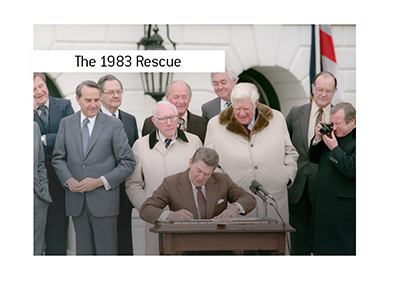
Congress and the White House fixed it with a deal that raised the retirement age, made benefits taxable for higher earners and pulled payroll tax increases forward. Ronald Reagan signed it on April 20, 1983, and the people who built it said it would keep the system in balance for the next 75 years.
It is on track to last about fifty. The trustees now project the combined trust funds will run out in 2034, decades sooner than the 1983 plan expected.
I went back through the law itself, section by section, to see what was actually changed, who gave up what, and why a fix that was supposed to balance the books for 75 years is running out early.
The Year Social Security Almost Ran Out of Money
The 1983 rescue, read the way it was written: as a law, with the old words struck out and the new ones put in.
This piece is built around the markups. Every section opens with a line of law, or a promise that was treated like one, with the old version struck out in red and the new one written in green. Then I explain what the change meant in plain English, and whether it held.
The fix before the fix
The 1983 crisis started with a rescue that didn't work. In 1977 Congress raised payroll taxes, raised the wage cap and trimmed benefits to shore up the system. When Jimmy Carter signed it on December 20, 1977, he said:
It barely held for three. By 1980 Congress had to shift payroll tax money from the disability fund to keep the retirement fund paying, and by November 1982 the retirement fund was borrowing just to send out checks. The 1977 plan assumed a normal economy, and the late 1970s were anything but. Social Security benefits rise every year with prices. The payroll taxes that pay for them rise with wages. When prices run ahead of wages, the system's bills grow faster than its income, and that is exactly what happened:
| Year | Benefit raise (COLA) | Wage growth | Gap |
|---|---|---|---|
| 1979 | 9.9% | 8.75% | 1.15 pts |
| 1980 | 14.3% | 9.01% | 5.29 pts |
| 1981 | 11.2% | 10.07% | 1.13 pts |
| 1982 | 7.4% | 5.51% | 1.89 pts |
Cost-of-living adjustments (effective each June, based on first-quarter-to-first-quarter price changes) against calendar-year growth in SSA's average wage index. From 1979 through 1982, benefits rose about 50% while average wages rose about 38%.
Benefit raises that outrun the wages paying for them, year after year, will break almost any budget. The system had been paying out more than it took in since 1975, and by 1981 the reserves that were supposed to carry it through a bad stretch were draining fast.
Teetering on the edge
The Reagan administration's first answer, in May 1981, was a package of cuts, and the biggest one landed on people planning to retire early. A worker retiring at 62 would have gone from 80% of their full benefit to 55%, starting the following year. That is a cut of nearly a third, with almost no warning, for people who had already planned their lives around the old number.
It went nowhere. On May 20, 1981, the Senate voted 96 to 0 for a resolution opposing any sudden, unfair cut in early retirement benefits. The next day Reagan wrote to congressional leaders that the system was "teetering on the edge of bankruptcy."
What they did instead was buy time. In December 1981 Reagan signed a law letting the struggling retirement fund borrow from the disability and Medicare hospital funds. That was expected to keep checks going out through June 1983. He called it "just a temporary solution."
The same month, on December 16, 1981, he created the National Commission on Social Security Reform by executive order. It had 15 members: five picked by the President, five by the Senate Majority Leader, Howard Baker, and five by the Speaker of the House, Tip O'Neill. Eight were Republicans and seven Democrats. It was chaired by an economist named Alan Greenspan, a few years before he ran the Fed.
The deal at Blair House
The commission met nine times and held no public hearings. By the fall it had agreed on how big the hole was, but not on how to fill it, and the November 1982 midterms came and went without a deal.
The money was on a schedule of its own. According to the Social Security Administration's own account, without new legislation it would not have been possible to keep paying benefits on time beginning in July 1983.
The deal that finally broke the stalemate was negotiated in January 1983, mostly outside the commission itself. On one side were Greenspan, Senator Bob Dole and Congressman Barber Conable, along with four of Reagan's top people: chief of staff James Baker, Richard Darman, budget director David Stockman and Kenneth Duberstein. On the other were Senator Daniel Patrick Moynihan and Robert Ball, the former Social Security commissioner who spoke for the Democratic side. The final session was held on the morning of January 15, 1983, at Blair House, across the street from the White House.
That evening, an hour or two before its authority expired, the full commission voted 12 to 3 to back the package. Ball later wrote: "Of all my experiences in Social Security, this was certainly one of the most memorable and most important." Reagan endorsed it the same day:
What the law actually changed
Here is the heart of it. These are the main changes in the final law, by section number, with the old rule struck out and the new one written in.
This was the big long-term saver. It didn't hurt anyone retiring in the 1980s, because it didn't start until 2000, and then only two months at a time. But it is a benefit cut all the same: retiring at 62 now costs you 30% of your benefit instead of 20%.
| Born in | Full retirement age | Cut if you retire at 62 |
|---|---|---|
| 1937 or earlier | 65 | 20% |
| 1938 | 65 and 2 months | 20.8% |
| 1943 to 1954 | 66 | 25% |
| 1957 | 66 and 6 months | 27.5% |
| 1960 or later | 67 | 30% |
Selected years from SSA's retirement age schedule. The age rose two months per birth year from 1938 to 1943, held at 66 for twelve years, then rose again from 1955 to 1960.
To soften it a little, the law also made waiting past full retirement age more rewarding. The bonus for each year you delay went from 3% to 8%, phased in by birth year.
Until 1984, Social Security checks were completely tax-free. After that, retirees with other income paid tax on up to half of their benefit, and the money collected was sent back into the Social Security trust funds. In 1993 Congress added a second tier taxing up to 85% of benefits for higher-income retirees, with that extra money going to Medicare instead. This was the single biggest long-term fix in the commission's own scoring. It also had a quiet feature that kept it growing: the $25,000 and $32,000 thresholds were set in 1983 dollars and never adjusted for inflation. Thresholds that once caught only well-off retirees now catch plenty of ordinary ones.
This one hit every person on Social Security at once, and it's why the raise still arrives in January. The 1983 increase was pushed back six months, which saved money immediately, when the system needed it most.
Workers and employers paid more, sooner. The rate increases were already in the law from 1977; the 1983 deal simply moved them up. Workers got a one-time credit against their 1984 payroll tax that cancelled out that year's bump, so employers carried it. Section 124 did the same thing for the self-employed, whose rate rose to the full combined employer and employee rate, softened by a tax credit through 1989 and, from 1990, a deduction for half of what they pay.
Bringing more people into the system meant more people paying in right away, while their benefits wouldn't come due for decades. It also meant that, for the first time, the people writing Social Security law would be paying into it.
Put it all together and the pain was spread around on purpose. Here is the commission's own estimate of what its proposals were worth, which is the closest thing to a scorecard that exists. It scored its package, not the final law, but the two are close:
| Change | Who paid | 1983 to 1989 | Long-term, % of payroll |
|---|---|---|---|
| Tax up to half of benefits | Retirees with other income | $30B | +0.60 |
| Bring in federal and nonprofit workers | New federal hires and nonprofit workers | $20B | +0.30 |
| Delay the COLA six months | Every beneficiary | $40B | +0.27 |
| Full rate for the self-employed | Self-employed | $18B | +0.19 |
| Pull payroll tax hikes forward | Workers and employers | $40B | +0.02 |
| Further long-term changes left to Congress, which chose the retirement age | Future retirees | - | +0.58 |
National Commission on Social Security Reform, January 1983. The full package was scored at $168 billion for 1983 to 1989, against a need of $150 to $200 billion, and scored to close the full 1.80% long-term gap. The rows above are its largest policy changes. Most of the remaining money was an $18 billion lump-sum Treasury payment to the trust funds for past military service credits and uncashed checks; smaller items include a cost for the bigger bonus for delaying retirement. The commission didn't agree on how to find the last 0.58%. By the time Congress acted, newer estimates had widened the remaining gap to about 0.68%, and Congress closed it by raising the retirement age.
Passed, signed and declared fixed
The bill moved fast once the deal was done. The House passed it 282 to 148 on March 9, 1983. The Senate passed its version 88 to 9 on March 23. A conference committee worked out the differences the next day, and both chambers approved the final version that same day, March 24. Reagan signed it on April 20, 1983.
He also said something that is still the best one-line summary of how it got done: "the essence of bipartisanship is to give up a little in order to get a lot."
The actuaries agreed that, on paper, it worked. The 1983 Trustees Report showed the system in balance over the full 75 years. According to Social Security's current Chief Actuary, Karen Glenn, the 1983 Trustees Report had the combined trust funds solvent through the next 75 years, "until roughly the early 2060s."
Why the fix is running out
Here is the current picture, from the 2026 Trustees Report:
"Runs out" doesn't mean the checks stop. Payroll taxes and the income tax on benefits keep coming in, and together they would still cover more than four-fifths of benefits. What happens on that date is an automatic, across-the-board cut. The reserves peaked at the end of 2020 and have been shrinking since 2021, when the program started paying out more than it took in, interest included. In 2025 alone, costs topped income by $160 billion.
So what went wrong? Social Security's actuaries have tracked the answer every year since 1983. The 75-year balance has gone from +0.02% to -4.42% of taxable payroll, a drop of 4.44 points. This is where it went:
| Cause | Points lost | Share | |
|---|---|---|---|
| The 75-year window moving forward | -2.51 | 56% | |
| The economy and economic assumptions | -0.90 | 20% | |
| Births, deaths and immigration | -0.51 | 12% | |
| Disability claims and assumptions | -0.31 | 7% | |
| Laws passed since | -0.26 | 6% | |
| Changes in methods and data | +0.05 | -1% |
SSA Office of the Chief Actuary, Actuarial Note 2026.8, June 2026. Shares are of the 4.44-point decline. Component figures are rounded.
The biggest cause isn't a forecasting mistake at all. The 1983 fix balanced the books over a 75-year window: 1983 to 2057. Every year since, the window has slid forward a year, dropping a cheap year at the front and adding an expensive one at the back. Nobody fixed the years after 2057, because nobody was asked to. That alone accounts for more than half the decline, and some version of it would have happened even if every other assumption had come true.
The rest is the real world being less kind than the forecast. Two pieces of it are worth knowing:
The first one is the part almost nobody talks about. Social Security tax only applies to wages up to a cap, which is $184,500 in 2026. In 1983, 90% of all earnings covered by Social Security fell under it. But pay at the top grew much faster than pay for everyone else, and by 2000 only about 82.5% did, roughly where it has stayed since. The Chief Actuary has testified that this "was not anticipated at the time of the 1983 Amendments." The second number is the baby boom doing what everyone knew it would: fewer workers paying in for every person collecting.
And Congress has made it worse along the way. In January 2025 the Social Security Fairness Act became law, repealing the Windfall Elimination Provision that the 1983 law created in Section 113, along with the Government Pension Offset, a related rule for spouses' and widows' benefits. The 2025 Trustees Report called the repeal the largest single factor in that year's worsening, the same year the combined depletion date moved up from 2035 to 2034. Six months later, the 2025 tax law locked in lower income tax rates and added a temporary extra deduction for people 65 and older. Both shrink the income tax collected on benefits, which is the money Section 121 sends back into the trust funds. The Chief Actuary estimated it pulled the combined depletion date from the third quarter of 2034 to the first. Between them, the two 2025 laws took 0.32 points off the long-term balance.
The 1983 rescue worked because it had to. The checks were months from going out late, so both parties signed on to things they hated: Republicans accepted tax increases, Democrats accepted benefit cuts, and everybody let a commission take some of the blame. The pain was spread so widely that nobody could claim to have been singled out.
It was also a fix with an expiry date built in. Balancing 75 years only balances 75 years, and the system has been sliding back into the red ever since. The 2026 shortfall is more than twice the size of the one the 1983 commission had to fill, and the deadline is about eight years out instead of a few months.
If 1983 is the template, the next deal will look a lot like the last one: some tax, some benefits, a later age or a higher cap, and a deadline close enough to make everyone sign. The longer it waits, the bigger the changes have to be.
Sources. Social Security Administration history pages on the 1977 and 1983 amendments, the National Commission on Social Security Reform and presidential statements by Carter and Reagan. Svahn and Ross, Social Security Amendments of 1983: Legislative History and Summary of Provisions, Social Security Bulletin, July 1983. Public Law 98-21, 97 Stat. 65. Report of the National Commission on Social Security Reform, January 1983. Robert M. Ball oral history, SSA. Senate Special Committee on Aging hearing record, June 1981. House and Senate roll calls via Voteview. 1983 and 2025 Social Security Trustees Reports; 2026 Trustees Report, released June 9, 2026. SSA Office of the Chief Actuary, Actuarial Note 2026.8, June 2026, and Chief Actuary testimony to the Senate Budget Committee, March 25, 2026. SSA Annual Statistical Supplement, Table 4.B1. SSA cost-of-living adjustment and average wage index series. SSA trust fund data, Table 4.A3. 2026 Trustees Report, covered workers and beneficiaries table. SSA Chief Actuary letter to Sen. Ron Wyden, August 5, 2025. Senate Finance Committee Report 96-946, 1980.
Filed under: General Knowledge