
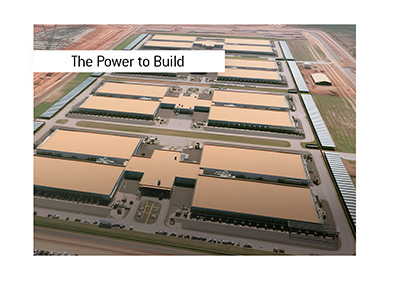
The answer turned out to be more interesting than yes or no. Texas already had a pause, and the Republican she beat put it there. So I went through the grid operator's own numbers, the tax break, the biggest projects and what happened in Singapore, Amsterdam and Dublin when they tried the same thing. Here is what a governor can actually do, what is already too far along to stop, and where the money tends to go when a state says no.
Texas already has a pause on new data centers. Greg Abbott imposed it himself, by letter, months before the election. Gina Hinojosa ran on making it law. Here is what a governor can and cannot do alone, how much of the boom is real and how much is paper, what the tax break costs, who has money riding on it, and what happened everywhere else that hit pause.
Jump to: What a pause stops · The queue · Two pauses · Her powers · The projects · The tax break · Your power bill · The stocks · What happened elsewhere · The clock
01What a pause actually stops
Start with the number that gets quoted most: hundreds of gigawatts of data centers trying to plug into ERCOT, the grid that covers most of Texas. It is real in the sense that someone filed the paperwork. It is not committed construction, and it far exceeds anything ERCOT itself expects to need soon.
ERCOT sorts every large load (75 megawatts and up) by how far it has got. In April 2026 the queue looked like this:
ERCOT Monthly Report, April 2026, large-load interconnection status (loads of 75 MW and up). The five stages are separate and add up to 445.8 GW. Source: ERCOT.
Nearly three-quarters of it had not submitted a single study. Only about 31 gigawatts, roughly 7%, had finished studies, been approved to switch on, or were actually running. So a pause on new grid connections mostly freezes projects that were still on paper.
Mostly, not entirely. When Abbott's audit began in August, ERCOT stopped approving data centers to switch on, and that caught about 17 projects, around 6.6 gigawatts, that had finished every other step (ERCOT to the PUC, August 20, 2026). Projects already approved to energize or already running carry on. Construction that is already authorized can continue, but projects can still face delays if they need more environmental permits or permission to switch on. For scale, Industrial Info Resources counted more than $89.5 billion of data center construction active across about 30 Texas counties in August 2026 (IIR).
02Five times the grid, asking to plug in
The queue did not creep up. It exploded. Requests to connect large loads went from about 63 gigawatts at the end of 2024 to more than 400 by spring 2026, against a grid whose record demand, set in July 2026, was about 91 gigawatts.
Large loads (75 MW and up) requesting connection to ERCOT. End of 2024 and November 2025: ERCOT board filing, December 2025; March 2026: ERCOT Senate testimony, April 2026; August 2026: Texas Tribune. ERCOT reports the queue on slightly different bases in different documents, so treat the line as the shape, not a precise series. Peak: ERCOT records, 91,089 MW on July 22, 2026.
ERCOT's own long-term forecast reached 367,790 megawatts by 2032, and the grid operator's chief executive, Pablo Vegas, said publicly that the agency believed the forecast was higher than the load growth it actually expects (ERCOT, April 15, 2026). That gap between paperwork and reality is why a Republican governor started asking questions first.
03One pause by letter, one by law
This is the part most of the coverage skips. Texas did not wake up on November 4 to a sudden threat of a data center pause. It already had one, and Abbott put it there.
| Abbott's pause (2026) | Hinojosa's moratorium (campaign) | |
|---|---|---|
| How | Letters directing ERCOT and the utility commission (August 3), the water board (September 14) and the environmental agency (September 21) | An emergency executive order, then legislation |
| What it holds | New data center grid approvals until an audit is done; state environmental permits for data centers until the ERCOT and water audits finish | New data centers until the Legislature writes rules |
| Legal footing | The letters cite no specific statute. ERCOT and the environmental agency said they would comply, though the agency kept processing some applications | She wants it written into law because, in her words, guidelines from the governor are not laws |
| When it ends | When the audits are done; ERCOT's report is due by December 10, 2026 | When lawmakers pass real protections |
| What else | Repeal the data center sales tax break; data centers add their own generation and pay for their own grid hookups; closed-loop water; annual reporting | Skilled, licensed union workers; end subsidies; a local say on where they go; no nondisclosure agreements; proof household power and water bills will not rise; water contracts unenforceable if they threaten a town's supply |
Abbott: Office of the Governor, August 3, 2026; Texas Tribune, September 21, 2026; Akin Gump; Bracewell. Hinojosa: campaign release, July 2026 and August 10, 2026 statement.
Her line in July was "I'm calling for a moratorium until a legislative session that puts Texans first." When data center companies praised Abbott's audit in August, her answer was "Guidelines from the governor aren't laws, they won't protect Texans, and that's exactly how Abbott's donors like it."
Read those two columns side by side and the change is narrower than the headlines suggest. Both candidates went after the data center tax break. Both wanted data centers to carry more of their own grid costs. The real difference is whether the pause stays a governor's instruction that can be lifted with another letter, or becomes a law, which is far harder to change.
04Can she pause data centers on her own?
Partly. A Texas governor has real levers over the agencies that approve data centers, and Abbott just showed how far a letter can go. That the agencies complied shows practical influence; it does not settle how far a governor's legal authority runs, or whether every restriction could be extended indefinitely. The things that would make a pause durable run through the Legislature.
| Executive actions and influence, subject to existing law | Needs the Legislature |
|---|---|
| Keep, extend or lift the existing audit and permit holds by directive | A moratorium with the force of law |
| Appoint utility and environmental commissioners as their six-year terms end (the state Senate confirms them); at least two utility commission seats come open in September 2027 | Repeal or change the data center sales tax exemption |
| Call special sessions, which last up to 30 days, and decide what is on the agenda | Rewrite SB 6, the 2025 law that set the rules for loads of 75 MW and up |
| Veto bills, and veto individual lines of the state budget | Make developers pay for transmission, ban nondisclosure agreements, or change how water contracts are enforced |
Texas Constitution, Article 3, Section 40 and Article 4, Sections 8 and 14; Utilities Code Section 12.051 and Water Code Section 5.052 (commissioner appointments); SB 6, 89th Legislature (signed June 20, 2025); Bracewell on SB 6.
The timing is awkward for her. The Legislature's 2027 regular session opens on January 12. She is sworn in on January 19. Until then, Abbott is still governor, and the pause is still his.
The other result that matters is the one below her on the ballot. Democrat Vikki Goodwin beat Lieutenant Governor Dan Patrick, who conceded. In Texas the lieutenant governor presides over the state Senate and, under the Senate's rules, appoints its committees and controls which bills reach the floor, which makes that office arguably more important to a data center bill than the governor's. How much of Hinojosa's agenda becomes law depends on a Legislature where Republicans went into the election holding both chambers.
05Which projects can a pause reach?
The surprise when you list the biggest projects is how many of them sit partly or entirely outside the thing being paused. An ERCOT connection hold does not directly cover a campus served by a different grid operator, and only partly touches one that brings its own power plant.
The catch is permits. Abbott's September letter to the environmental agency held state permits for data centers generally, and on-site gas plants need air permits. A campus that brings its own power dodges the grid queue, not necessarily the permit desk.
| Project | Who | Size | Stage | Power |
|---|---|---|---|---|
| Stargate, Abilene | Crusoe; OpenAI and Oracle | About 1.2 GW | Partly running; more buildings under way | ERCOT plus an on-site gas plant |
| Frontier, Shackelford County | Vantage (a Stargate site) | 1.4 GW, more than $25 billion | Under construction | Reported to run on on-site gas |
| Milam County | SB Energy (OpenAI lease) | About 1.2 GW | Planned | ERCOT |
| Helios, Dickens County | Galaxy Digital; CoreWeave tenant | Over 1.6 GW of approved and contracted power | First phase delivered | ERCOT |
| El Paso | Meta, with BlackRock | About 1 GW, about $14 billion | Online from 2028 | Outside ERCOT (El Paso Electric) |
| Amarillo | Fermi America | Up to 11 GW of on-site power planned | Early stage; a 222 MW lease signed in 2026, pending closing | Mostly its own power |
| Armstrong and Haskell counties | Part of a $40 billion Texas commitment through 2027 | Announced | ERCOT |
Sizes and stages as reported by the companies and in filings in 2025-26: DCD on Abilene; Vantage and on its power; OpenAI on Milam County; Galaxy and its first phase; Meta; The Register on Fermi; Google.
As of October 2026, Texas was not yet the biggest data center state by capacity actually running; Virginia still was. Where Texas leads is what is under construction. One tracker that counts every kind of facility, including crypto mining, put Texas at 17.2 gigawatts under construction against Virginia's 5.5 in October 2026 (Baxtel). That is the future a pause puts a question mark over.
06The tax break both candidates went after
If one thing is likely to change no matter who governs, it is the sales tax exemption. Texas exempts qualifying data centers from the state sales tax on their equipment and on the electricity they buy. To qualify, a center needs at least 100,000 square feet, 20 jobs paying at least 120% of the county average wage and $200 million of investment over five years; a larger tier needs 250,000 square feet, 40 jobs and $500 million. The exemption runs for 10 years for an investment of $200 million to under $250 million, 15 years for $250 million or more, and 20 years for the larger tier, and covers the 6.25% state tax, not local sales tax.
Estimated state sales tax revenue lost to the data center exemption. Fiscal 2025-2030 from the Texas Comptroller's January 2025 tax exemptions report, as reproduced by the Baker Institute (October 2026); 2015 from the Texas Tribune. Fiscal 2027 onward are projections. Statute: Texas Comptroller.
When lawmakers passed it in 2013, it was a few million dollars a year. Now it is more than a billion, and the Comptroller's chief revenue estimator told the Senate Finance Committee in July 2026 that "the next estimate will be significantly higher." At the time, the Comptroller's office had audited 20 of the 138 data centers certified for the break, and six of those were out of compliance.
Abbott asked the 2027 Legislature to repeal it in June. Hinojosa called it a "tax giveaway" and ran on ending data center subsidies (campaign release, April 2026). When a Republican governor and the Democrat who beat him both go after the same tax break, that is a clear area of bipartisan pressure. It is not a guarantee: agreement between candidates says nothing about whether a bill passes, when, or whether centers already certified keep their exemptions. A repeal would not necessarily recover the whole estimated annual cost right away, either; that depends on the effective date and how existing projects are treated.
07What it means for your power bill
The reason voters cared is the electric bill. A Federal Reserve Bank of Dallas working paper estimated that data center load added $3.15 a megawatt-hour, about 12.6%, to ERCOT wholesale power prices over 2024-25 (Kay, Reaser and Taylor, Processing Power: The Effect of Data Centers on Wholesale Electricity Markets, Dallas Fed Working Paper 2606, revised October 9, 2026, page 28 and Figure 4). That is a modeled, mid-range estimate of the effect on wholesale prices, and it does not mean residential electricity bills rose 12.6% because of data centers. Texas has kept the effect smaller than it might have been by building a lot of new generation, but wholesale prices do feed retail bills, and the queue above is the reason people worry about what comes next.
SB 6, the 2025 large-load law, already lets ERCOT cut power to large loads connected after 2025 during a grid emergency, and the utility commission's 2026 rule requires new large loads to post $50,000 a megawatt in financial security to get in line for a connection (White & Case). In a state that still remembers Winter Storm Uri, that is not an academic point.
For the state-by-state numbers on electricity prices and data center growth, see Is AI Raising Your Power Bill?.
08The stocks riding on it
The market read the result instantly. On the morning after the election the Dow rallied (CNN), while AI infrastructure stocks with big Texas plans sold off, CoreWeave, Oracle and Nebius among them (CNBC). Other market reports tied part of the selling to the broader Democratic sweep of Congress, not only to Texas (Investing.com).
Vistra, the biggest power generator in Texas, fell too, and KeyBanc downgraded it the same morning, calling the Texas result a "negative surprise" (Investing.com). Morgan Stanley's view, as relayed by a Thai brokerage, was that restrictions would not end AI spending growth, but could split the country into states that encourage building and states that restrict it. Elon Musk's reaction to the night was that "data centers in space" were looking pretty appealing.
| Who | Why Texas matters to them |
|---|---|
| Developers and tenants building in Texas | Stargate sites in Abilene, Shackelford and Milam counties; CoreWeave at Galaxy's Helios campus; IREN's Texas sites |
| Texas power generators | Data center demand was the growth story; a slower queue means slower load growth |
| Grid and cooling equipment | Fewer new campuses, fewer orders |
| Data centers already running | When new supply is scarce, existing capacity tends to get more valuable |
| Other states | Where precedent says the next project goes |
I would not read too much into one morning of trading. The more durable question is whether the projects move or just slow down. For what the biggest spenders are actually putting into AI, see the Big Tech AI Spending Tracker; for the bigger picture, how the stock market does after midterm elections.
09When other places hit pause
Texas is not the first place to hit pause, and the record is consistent enough to be useful.
| Place | What was paused | What happened next |
|---|---|---|
| Singapore | New data centers, from 2019 | Eased in 2022 with a pilot; about 80 MW went to four operators in 2023. Demand moved across the border to Johor, Malaysia: from about 10 MW of operating capacity in 2021 to more than 1,500 MW of operating and planned capacity combined by 2024. |
| Amsterdam area | New permits, from July 2019 | Replaced in 2020 with zones, power budgets and efficiency rules. In 2022 the Netherlands barred new hyperscale sites outside two municipalities, and Meta paused its Zeewolde project. |
| Dublin | New grid connections, from late 2021 | Expected to last to about 2028. Approved projects kept building, and data centers reached about 22% of Ireland's metered electricity in 2024. In December 2025 the regulator set a national rule that new sites bring their own generation or storage, though Dublin's grid constraints still apply. |
| Loudoun County, Virginia | By-right approval, from March 2025 | New projects now need a special-exception vote by the county board after a public hearing. Northern Virginia still added more than 1 GW of capacity in 2025. |
| New York | State environmental permits for sites of 50 MW and up, from July 2026 | The first statewide pause on permitting of this kind; no end date set. |
DCD on Singapore; W.Media on Johor; DCD on Amsterdam; CMS on the Netherlands; Ireland CSO; Irish Times; McGuireWoods on Loudoun; CBRE; Davis Wright Tremaine on New York.
Several of these show restrictions evolving into conditional approvals, with projects that were already approved still adding load and some demand shifting to other markets. The timing and extent vary considerably: Dublin's limits have lasted years, and New York's pause is too recent to judge. As of early November 2026, no US state had a data center moratorium written into law. Maine's Legislature passed one in 2026 and the governor vetoed it, and New York's Legislature sent its governor a one-year ban on new data center permits that was still awaiting her decision (Bloomberg Government).
For Texas, next door means Louisiana, Oklahoma and New Mexico, and the El Paso project already sits outside ERCOT. The question for the state is not whether the AI boom continues. It is how much of it Texas still wants, and on what terms.
10The data center clock
A Democratic governor does not end the Texas data center boom, and it was already on pause before she won. What changes is who decides how long the pause lasts and what it takes to lift it. The queue far exceeds credible near-term demand and was never committed construction; projects already under construction mostly continue, though some still need permits or approval to switch on; and the tax break was under pressure either way. The things to watch are the ERCOT audit in December, what she does with Abbott's letters in January, and what a Legislature with a Democratic lieutenant governor actually passes. If other places are a guide, the boom is more likely to get rules than to stop, and some of it may move next door.
More on DaveManuel.com: Is AI Raising Your Power Bill? · Big Tech AI Spending Tracker · Midterm polls and prediction markets tracker · The stock market after midterm elections · Midterm election history
Sources
- Election: CBS Texas; Texas Tribune; KPRC on the lieutenant governor race
- Abbott's directives: Office of the Governor, August 3, 2026; ERCOT market notice, August 3, 2026; Texas Tribune, September 21, 2026; DLA Piper; Abbott's June 2026 recommendations (KRGV)
- Hinojosa: campaign release, July 2026; statement, August 10, 2026; Bloomberg Government
- Grid: ERCOT Monthly Report, April 2026; ERCOT presentation to the PUC, August 20, 2026; ERCOT preliminary long-term load forecast; ERCOT all-time records; Industrial Info Resources; Bracewell on SB 6; White & Case on the PUC large-load rule
- Tax: Texas Comptroller, data center exemption; Baker Institute working paper, October 2026; Texas Tribune, July 27, 2026
- Prices: Kay, Reaser and Taylor, Dallas Fed Working Paper 2606 (revised October 2026)
- Markets: CNBC, November 4, 2026; CoinDesk; Investing.com on KeyBanc; Kaohoon on Morgan Stanley
- Elsewhere: Maine Morning Star and the sources under the table in section 9