
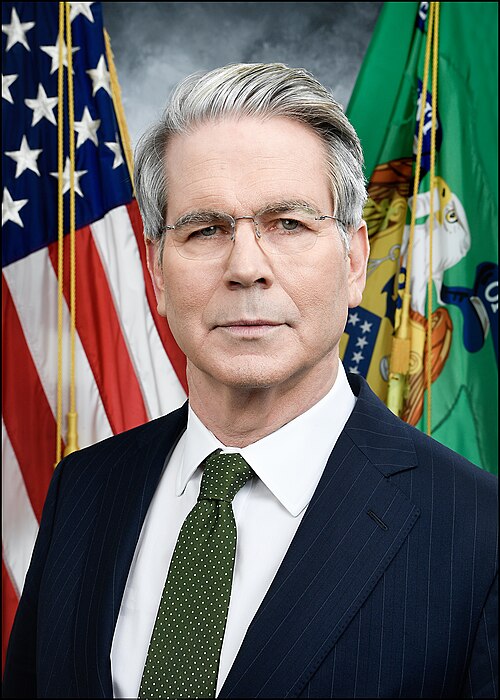
Scott Bessent
01Overview
Reconstructed from the government ethics filing he made when Donald Trump nominated him to run the Treasury, Scott Bessent's wealth comes to about $600 million ($601 million in our detailed calculation). The holdings behind that figure are dated late 2024, and his current net worth cannot be established from the disclosures available. The filing put his assets at a minimum of $521 million, a floor rather than a total, because nine holdings were reported only as "over $50 million"1. Our illustrative scenarios run from about $333 million to $743 million.
Almost all of it came from hedge funds. Bessent spent two stints, about 13 years in all, with George Soros, running his London office during the 1992 bet against the British pound and returning as chief investment officer during the 2012-2013 bet against the yen, then founded his own firm, Key Square Group, in 2015 with a $2 billion commitment from Soros. To become Treasury Secretary he had to sell nearly everything; by December 2025 he had certified to the government ethics office that the sales were complete3.
His 2025 annual report shows a lower floor, at least $228 million5. The floor alone does not tell us how much was lost, if anything: once the Key Square positions were sold, most of the reported value sat in three cash accounts each reported only as "over $50 million". Consolidation into fewer open-ended accounts can reduce the reported floor without any corresponding decline in actual wealth; the form cannot show whether taxes, losses or spending also played a part.
| Born | August 21, 1962 |
| Age | 64 |
| Role (as of October 2026) | 79th U.S. Treasury Secretary, sworn in January 28, 2025 |
| Source of wealth | Hedge funds: Soros Fund Management and Key Square Group |
| Spouse | John Freeman, a former New York City prosecutor (married 2011) |
02Reconcile the Estimate
Bessent's wealth can only be read from government ethics filings, which value assets in broad ranges and put everything above $50 million in a single open-ended bracket. Our base case takes the midpoint of every bounded range in his January 2025 nominee filing1, counts each of the nine "over $50 million" items at exactly $50 million, subtracts his disclosed debts the same way, and adds the Charleston home he sold weeks later, which the form did not have to list. Each value below is our model, built from a disclosed range; the form itself reports only the ranges. The biggest open question is three holdings the filing lists as open currency positions, each over $50 million: the disclosure does not say whether those amounts are money he had at stake or the size of the positions, and the answer moves the result by about $150 million (see the scenarios below).
| Counted | Basis | Value |
|---|---|---|
| Key Square fund positionsDisclosed range; value modeled | Eight holdings over $50 million (S&P 500, Nasdaq-100 and equal-weight S&P ETFs, two Treasury bill issues, three currency positions), three put options and 16 smaller trust lines, at range midpoints1 | $481M |
| Key Square Group interestDisclosed range; value modeled | His stake in the management company, reported as over $50 million; counted at $50 million1 | $50M |
| Real estate on the filingDisclosed range; value modeled | Bahamas and Cashiers, N.C. homes ($5 million to $25 million each), a Charleston commercial building and two land parcels, at range midpoints | $34.1M |
| North Dakota farmlandDisclosed range; value modeled | High Plains Acres LLP, $5 million to $25 million plus its cash; sold in December 2025 for a promissory note4 | $15.9M |
| Cash, money market funds, private funds, art and otherDisclosed range; value modeled | More than a dozen money market and bank accounts at $1 million to $5 million each, private funds, art and antiques, retirement and spouse accounts; the remainder of the filing at range midpoints | $69.7M |
| John Ravenel House, CharlestonPublic record | Personal residence, so not on the form; sold for $18.25 million, deed recorded February 28, 20256. The buyer also paid $3 million for the contents, which we leave out (see below) | $18.25M |
| Less: disclosed debtsLiability | Goldman Sachs margin loan over $50 million (counted at $50 million), Bank of America credit line ($5 million to $25 million) and mortgage ($1 million to $5 million), at midpoints1 | ($68M) |
| Model total (reconstruction of holdings dated late 2024; shown above as about $600 million) | $601M | |
Estimated Gross Assets Before Debt (about $669M, not the $601M net figure)
| Key Square fund positionsDisclosed range; value modeled | $481M | 72% | |
| Key Square Group interestDisclosed range; value modeled | $50M | 7% | |
| Real estate on the filingDisclosed range; value modeled | $34.1M | 5% | |
| North Dakota farmlandDisclosed range; value modeled | $15.9M | 2% | |
| Cash, money market funds, private funds, art and otherDisclosed range; value modeled | $69.7M | 10% | |
| John Ravenel House, CharlestonPublic record | $18.25M | 3% |
Solid: holdings counted from a filing value, a market price or a public record. Hatched: values we modeled or estimated, including values taken from disclosed ranges.
| Left out | Why | Value |
|---|---|---|
| Charleston house contents | The buyer paid $3 million for the contents on top of the house price. The nominee filing, dated before the sale, separately lists art and antiques at $1 million to $5 million, and nothing on the record shows whether those pieces were among the contents sold. To avoid counting the same objects twice, the $3 million is left out; if none of the contents were on the art line, the estimate would be up to $3 million higher. | $3M not added |
| Value above the top bracket | Nine assets and the Goldman Sachs loan are reported only as "over $50 million". Each is counted at $50 million. Every $10 million an open-ended asset sits above $50 million adds $10 million to the estimate; every $10 million the loan sits above $50 million takes $10 million off. Use the assumption explorer below to try other values. | Not counted |
| Georgetown house, Washington, D.C. | Bought for $12.5 million in early 20257. Treated as paid for out of the filing's cash, so it moves money between rows rather than adding to the total. | Not added |
| Farmland promissory note terms | The buyer and price of the North Dakota farmland were not disclosed; it is carried at the filing range midpoint. | Unknown |
| Taxes and investment returns since 2024 | Gains, losses and taxes from selling the Key Square positions in 2025 are not disclosed; the Office of Government Ethics can issue certificates of divestiture that defer capital gains tax when proceeds go into approved holdings, but none has been disclosed for him. | Not modeled |
Scenarios: What Each Assumption Does
The filing gives ranges, not values, so the estimate depends on four choices. Each row below makes them differently.
| Scenario | Currency positions | Bounded asset ranges | Open-ended assets | Debts | Result |
|---|---|---|---|---|---|
| Low | Left out (in case the amounts are exposure, not equity) | Minimums | $50M each (6 items) | $56M: bounded debts at minimums, loan at $50M | $332.8M |
| Base case | Counted at $50M each | Midpoints | $50M each (9 items) | $68M: bounded debts at midpoints, loan at $50M | $601M |
| High, debts at floor | Counted at $50M each | Maximums | $50M each (9 items) | $56M: bounded debts at minimums, loan at $50M | $743.2M |
| High, bounded debts at maximums | Counted at $50M each | Maximums | $50M each (9 items) | $80M: bounded debts at maximums, loan still at $50M | $719.2M |
All four add the Charleston house at its $18.25 million sale price. None can show his wealth today: they are reconstructions of holdings dated late 2024, before gains, losses, taxes and spending since. The open-ended items cut both ways: every $10 million above $50 million adds $10 million for an asset and subtracts $10 million for the margin loan.
Values from his nominee OGE Form 278e as of about December 28, 2024, as amended in 2025, with the spouse account corrected in 2026; the Charleston sale from county deed records as reported in March 2025. Whose wealth this is: the household as the ethics form defines it, which is Bessent, his husband John Freeman and any dependent children, including assets held through trusts, partnerships and LLCs in which they have a beneficial interest (the Key Square lines held in the C.P. 2012 Trust and the Palmetto 2020 Trust are counted in full, as the form reports them). Assets the household does not own, such as those of the Bessent Freeman Family Foundation, a charity, are not counted.
Not observable: Where each "over $50 million" item actually sits above $50 million; whether the reported currency positions were equity or notional exposure; the farmland sale price; and how the sale proceeds have been invested since. His 2025 annual report, certified September 22, 2026, shows most of the reported value at the end of 2025 in three cash accounts reported as over $50 million each5.
Assumption Explorer
Change the assumptions behind the estimate and see what each one does. The results are illustrative: they rebuild the same disclosure under different readings and say nothing about wealth today.
Loading the explorer...
03Published Estimates
| Source | Date | Estimate |
|---|---|---|
| DaveManuel.com (reconstruction of late-2024 holdings) | October 2026 | About $600M (model $601M; scenarios $333-743M) |
| Forbes | June 10, 2025 | About $600M |
| The New York Times (assets in his nominee filing) | January 11, 2025 | More than $700M in assets |
| Fortune (sum of the filing's ranges) | January 12, 2025 | At least $521M in assets |
| Bloomberg (2025 annual filing) | September 22, 2026 | At least $228M in assets |
The filing figures are floors for assets, not net worth: they leave out debts and count every open-ended holding at its minimum. Forbes has not published how it arrives at its number.
04What the January 2025 Filing Showed
Grouped from the line items of his nominee OGE Form 278e. The holdings and their ranges are disclosed; the values are ours, with each range at its midpoint and each open-ended item at $50 million. The bars show each group's share of about $669M of estimated gross assets before debt, not of net worth. Values are as of about December 28, 2024, before he sold out of Key Square.
| Asset | Value |
|---|---|
| Key Square fund positionsETFs, Treasury bills, currency positions and put options held through Key Square partnerships and two family trusts | $481M |
| Key Square Group interestHis stake in the management company | $50M |
| Cash, money market funds and otherMoney market and bank accounts, private funds, art and antiques, retirement and spouse accounts | $69.7M |
| Real estate on the filingHomes in the Bahamas and Cashiers, N.C., a Charleston commercial building, two land parcels | $34.1M |
| John Ravenel House, Charleston (sold)Not on the filing as a personal residence; sold February 2025 for $18.25 million (the $3 million contents payment is not added) | $18.25M |
| North Dakota farmland (sold)High Plains Acres LLP; sold December 2025 | $15.9M |
| Total assets | $669M |
| Less: Goldman Sachs margin loanTaken out in 2024 at SOFR plus 0.51%, payable on demand; reported as over $50 million | ($50M+) |
| Less: Bank of America line of creditOpened 2018 at SOFR plus 1.75% | ($5M-$25M) |
| Less: Bank of America mortgage2020 mortgage on a personal residence at 2.75% | ($1M-$5M) |
| Model total after disclosed debts (reconstruction, holdings as of late 2024) | $601M |
How the totals work: the filing's ranges add up to $521 million at the bottom and $786 million at the top (counting each over-$50-million item at $50 million). Correcting a spouse account that was over-reported, taking midpoints and adding the Charleston house at its sale price gives about $669M in estimated gross assets; subtracting $68 million of debts (bounded debts at midpoints, the margin loan at $50 million) gives $601M, which we round to about $600 million.
05Current Position and Former Roles
| Organization | Role |
|---|---|
| U.S. Department of the Treasury | Secretary of the TreasuryNominated November 22, 2024; confirmed 68-29 on January 27, 2025; sworn in January 28, 2025. Also acting commissioner of the IRS from August 2025 to March 2026 and briefly acting head of the CFPB in February 2025 |
| Key Square Group | Founder, chief executive and chief investment officer (2015-2025)Resigned on confirmation and sold his interests in early 2025 |
| Soros Fund Management | Chief investment officer (2011-2015); managing partner, London (1991-2000) |
| Bessent Capital | Founder (2000-2005) |
| Yale University | Adjunct professor of economic history |
06Timeline: From Conway to the Treasury
| 1962 | Born August 21 in Conway, South Carolina. | |
| 1984 | Graduates from Yale with a degree in political science; starts at Brown Brothers Harriman, then works for the Olayan Group and Jim Chanos's Kynikos Associates. | |
| 1991 | Joins Soros Fund Management and runs its London office. | |
| 1992 | A key member of the Soros team that bets against the British pound on Black Wednesday, a trade that made Soros more than $1 billion. | $1B+ to Soros |
| 2000 | Leaves to start Bessent Capital, which he closes in 2005. | |
| 2011 | Returns to Soros as chief investment officer. | |
| 2013 | The Soros bet against the yen under Abenomics makes the fund roughly $1 billion. | About $1B |
| 2015 | Founds Key Square Group, which raises about $4.5 billion including a $2 billion commitment from Soros; it starts trading in January 2016. | |
| 2017 | Key Square peaks at $5.1 billion in assets. Soros takes back most of his $2 billion in 2018, and by December 2023 the firm manages $577 million. | |
| 2024 | Nominated for Treasury Secretary on November 22. | |
| 2025 | Nominee filing made public January 11 shows at least $521 million in assets. Confirmed 68-29 on January 27, sworn in the next day. Sells the John Ravenel House in Charleston for $21.25 million with contents, then a record for a Charleston home (passed in October 2025). In August the ethics office tells the Senate he missed divestiture deadlines; in December he sells the farmland and certifies all divestitures complete. | At least $521M |
| 2026 | His annual report for 2025, certified September 22, shows the money mostly in cash: at least $228 million, with three accounts reported as over $50 million each. |
07Profile
| Birthplace | Conway, South Carolina |
| Residence (2025-26) | Washington, D.C. |
| Education | Yale University, B.A. in political science, 1984 |
| Children | Two |
| Firm founded | Key Square Group, 2015 |
| Senate vote | Confirmed 68-29, January 27, 2025 |
08The Trades That Made Him
Bessent grew up in South Carolina and went to Yale, where he switched majors twice before settling on political science. After stints at Brown Brothers Harriman, the Olayan Group and short-seller Jim Chanos's Kynikos Associates, he joined George Soros in 1991 and ran Soros Fund Management's London office for most of the next decade.
That put him in the room for the most famous currency trade ever made. In September 1992 Soros bet against the British pound and made more than $1 billion when Britain was forced out of the European exchange rate mechanism. Stanley Druckenmiller is usually credited as the trade's architect; Bessent, then 30, was a key member of the London team.
Twenty years later, as Soros's chief investment officer, he helped run the firm's bet that Japan's new government would drive the yen down. Bloomberg reported in February 2013 that Soros had made almost $1 billion on the yen since the previous November.
09Key Square
Bessent left Soros in 2015 to start Key Square Group. It opened in January 2016 with about $4.5 billion, including a $2 billion commitment from Soros, returned 13% in its first year and peaked at $5.1 billion at the end of 2017. Then the money went the other way: Soros took back most of his $2 billion in 2018, institutional investors left, and by December 2023 the firm managed $577 million.
By the time he was nominated, his January 2025 filing shows Key Square operating largely as a vehicle for his own money: eight market positions reported as over $50 million each, alongside a Goldman Sachs margin loan of over $50 million and his stake in the management company itself.
10Selling Everything
His ethics agreement required him to resign from Key Square on confirmation and sell his Key Square interests and the rest of a 25-item list of holdings within 90 days. He sold the Key Square interests between February and March 20252 and said he had divested more than 90% of what he had to sell before taking office.
The rest took longer. In August 2025 the Office of Government Ethics told the Senate that Bessent had failed to timely comply with his ethics agreement; Treasury ethics officials said the remaining holdings included the North Dakota farmland, a private equity fund, a sparkling water company and a drug developer. He sold the farmland in December 2025 for a promissory note and certified all required divestitures complete on December 5, 20253. A separate review found that a JPMorgan Chase stake owned by his husband had been listed by mistake as cash; the Treasury inspector general found no knowing violation, and the stock was sold in July 2025.
11The Houses
Bessent and Freeman have bought and sold at least 20 properties over the years, according to the Wall Street Journal, including homes in Manhattan, Southampton, Bedford Hills and Miami Beach. The best known was the John Ravenel House at 5 East Battery in Charleston, bought in 2016 for $6.5 million and sold in February 2025 for $18.25 million plus $3 million for its contents, then a record for a Charleston home (passed in October 2025).
The ethics form only lists property that produces income or is held as an investment, so his filing shows homes in the Bahamas and Cashiers, North Carolina, and a commercial building in Charleston, but not the Charleston house he lived in. In early 2025 he bought a five-bedroom house in Georgetown, Washington, for $12.5 million.
12Treasury Secretaries by Disclosed Wealth
Figures are floors or estimates from financial disclosures at different dates and are not adjusted for inflation, so treat the order as rough.
| Secretary | Year | What the disclosure or reporting showed |
|---|---|---|
| Scott Bessent | 2025 | At least $521 million in assets; our reconstruction about $600 million |
| Henry Paulson | 2006 | More than $470 million in Goldman Sachs stock; net worth estimated at over $700 million |
| Steven Mnuchin | 2017 | Up to about $500 million, including real estate added after his first filing |
| Robert Rubin | 1996 | More than $57 million in family assets, possibly over $80 million |
Paulson could defer capital gains tax on his Goldman shares with a certificate of divestiture, which lets an official roll sale proceeds into approved holdings such as Treasury securities; whether Bessent received any has not been disclosed.
13Frequently Asked Questions
What is Scott Bessent's net worth?
His current net worth cannot be established from public filings. Reconstructed from his January 2025 government ethics filing, with holdings dated about December 28, 2024, it comes to about $600 million ($601 million in our detailed calculation), with illustrative scenarios of $333 million to $743 million. Forbes put him at about $600 million in June 2025. His filing showed at least $521 million in assets and more than $56 million of debt.
Is Scott Bessent a billionaire?
No public filing or estimate shows him as a billionaire. His nominee filing reported assets in ranges that add up to $521 million to about $786 million, counting nine open-ended holdings at $50 million each.
Why did Bessent's reported wealth drop to $228 million?
Not necessarily. Ethics forms report ranges, with a single open-ended bracket for anything over $50 million. After he sold his Key Square positions, most of the reported value sat in three cash accounts each reported as over $50 million. Consolidation into fewer open-ended accounts can reduce the reported floor without any corresponding decline in actual wealth; the form cannot show whether taxes, losses or spending also reduced it.
How did Scott Bessent make his money?
Hedge funds. He worked for George Soros from 1991 to 2000 and again as chief investment officer from 2011 to 2015, then founded Key Square Group, which managed as much as $5.1 billion.
Did Bessent sell his investments to become Treasury Secretary?
Yes. He resigned from Key Square, sold his interests in early 2025, and after the ethics office said he had missed deadlines, sold the rest, including North Dakota farmland, and certified the divestitures complete on December 5, 2025.
14Sources and Method
This is a disclosure-based estimate. Bessent's nominee OGE Form 278e, with values as of about December 28, 2024 and amended in 2025, reports every asset in a value range; we take the midpoint of each bounded range and count each of the nine holdings in the open-ended "over $50 million" bracket at exactly $50 million. We correct one spouse account that was reported at $1 million to $5 million but was later found to be $100,000 to $250,000 of JPMorgan stock. Debts are taken the same way: the Goldman Sachs margin loan at its $50 million floor and the two Bank of America loans at their midpoints. We then add the Charleston house he sold in February 2025 at its $18.25 million sale price, which the form did not have to list; the $3 million paid for its contents is left out because it may overlap the art and antiques the form already lists. That gives a model total of $601M, which we present as about $600 million because it reconstructs holdings dated late 2024 rather than measuring wealth today. The estimate covers the household as the form defines it: Bessent, his husband and any dependent children, including trusts, partnerships and LLCs in which they hold a beneficial interest.
The selected scenarios show the biggest unknowns: $333 million takes every asset range at its minimum, with debts at their $56 million floor, and leaves out the three currency positions entirely, in case their reported amounts reflect exposure rather than equity; $743 million takes every asset range at its maximum, with debts held at their $56 million floor (about $719 million with the upper ends of the bounded debt ranges, the open-ended margin loan still assumed at $50 million). All of them count the open-ended items at $50 million. That cuts both ways: every additional $10 million in an open-ended asset adds $10 million, and every additional $10 million of the open-ended loan, or of any debt we have not counted, takes $10 million off. The currency positions are the largest single question: the filing identifies them as open currency positions but does not resolve whether the reported amounts are equity or exposure. We have not adjusted for gains, losses, taxes or spending since the filing date, which the forms do not show.
- Ethics filings: nominee OGE Form 278e (OGE; line items transcribed by ProPublica; amended copy); periodic transaction reports (July 2025; December 2025); OGE letter to the Senate, August 2025 (OGE); compliance certification, December 2025 (OGE).
- Coverage of the filings: Fortune, January 12, 2025; Hedgeweek, January 13, 2025; Reuters, August 13, 2025; Axios, December 7, 2025; Bloomberg, September 22, 2026; Benzinga, September 2026.
- Estimates: Forbes, June 10, 2025; Forbes, August 13, 2025.
- Career: Treasury biography; Miller Center; Yale Alumni Magazine; Fortune, November 23, 2024; Bloomberg, February 14, 2013; confirmation vote (Congressional Record); swearing-in (Treasury).
- Real estate: Post and Courier, March 2025; Washingtonian, April 11, 2025; Charleston's later record sale (Post and Courier, 2025); Wall Street Journal; North Dakota farmland (Agweek).
- Earlier Treasury Secretaries: Paulson (Accounting Today, 2006); Paulson's divestiture certificate (New York Sun, 2006); Mnuchin (Fortune, 2017); Rubin (Seattle Times, 1997).
1 Nominee OGE Form 278e, values as of about December 28, 2024, made public January 11, 2025 and later amended: assets in ranges summing to $521 million to $786 million, nine items reported as over $50 million, and liabilities of a Goldman Sachs margin loan over $50 million, a Bank of America line of credit of $5 million to $25 million and a Bank of America mortgage of $1 million to $5 million.
2 Periodic transaction report signed July 14, 2025: sales of Key Square interests recorded between February 11 and March 25, 2025.
3 Ethics agreement compliance certification signed by Bessent on December 5, 2025; his December 2025 ethics agreement amendment, sent to the Office of Government Ethics with a Treasury cover letter dated December 8, 2025, provided for the farmland sale in exchange for a promissory note (ethics agreement).
4 The farmland, held through High Plains Acres LLP in five North Dakota counties, was reported at $5 million to $25 million. Its buyer and sale price were not disclosed.
5 Bloomberg, September 22, 2026, on his annual report for 2025, certified by the Office of Government Ethics the same day: assets of at least $228 million, including three cash accounts reported as over $50 million each; also reported by Benzinga, September 2026.
6 Post and Courier, March 2025, from Charleston County deed records: 5 East Battery sold for $18.25 million plus $3 million for contents; bought in 2016 for $6.5 million.
7 Washingtonian, April 11, 2025, citing the Wall Street Journal: a Georgetown house bought from Connie Milstein for $12.5 million.
Holdings valued: About December 28, 2024 (nominee filing). Latest annual filing: 2025 holdings, certified September 22, 2026. Page last reviewed: October 26, 2026. Net worth figures are estimates built from public filings and reporting; private holdings are valued conservatively and may differ from what the person would report.
Cite This Page
This page is free to cite and link. Please include the date you accessed it.
| Format | Citation | Copy |
|---|---|---|
| Plain | Dave Manuel, “Scott Bessent Net Worth,” DaveManuel.com, updated October 26, 2026, https://www.davemanuel.com/net-worths/scott-bessent/ (accessed October 26, 2026). | Copy |
| APA | Manuel, D. (2026). Scott Bessent Net Worth. DaveManuel.com. Retrieved October 26, 2026, from https://www.davemanuel.com/net-worths/scott-bessent/ | Copy |
| Chicago | Manuel, Dave. “Scott Bessent Net Worth.” DaveManuel.com. Accessed October 26, 2026. https://www.davemanuel.com/net-worths/scott-bessent/. | Copy |
| Wikipedia | {{cite web |url=https://www.davemanuel.com/net-worths/scott-bessent/ |title=Scott Bessent Net Worth |last=Manuel |first=Dave |website=DaveManuel.com |access-date=2026-10-26}} | Copy |
| Link (HTML) | <a href="https://www.davemanuel.com/net-worths/scott-bessent/">Scott Bessent Net Worth (DaveManuel.com)</a> | Copy |
Page last updated October 26, 2026. How we build our data pages.